
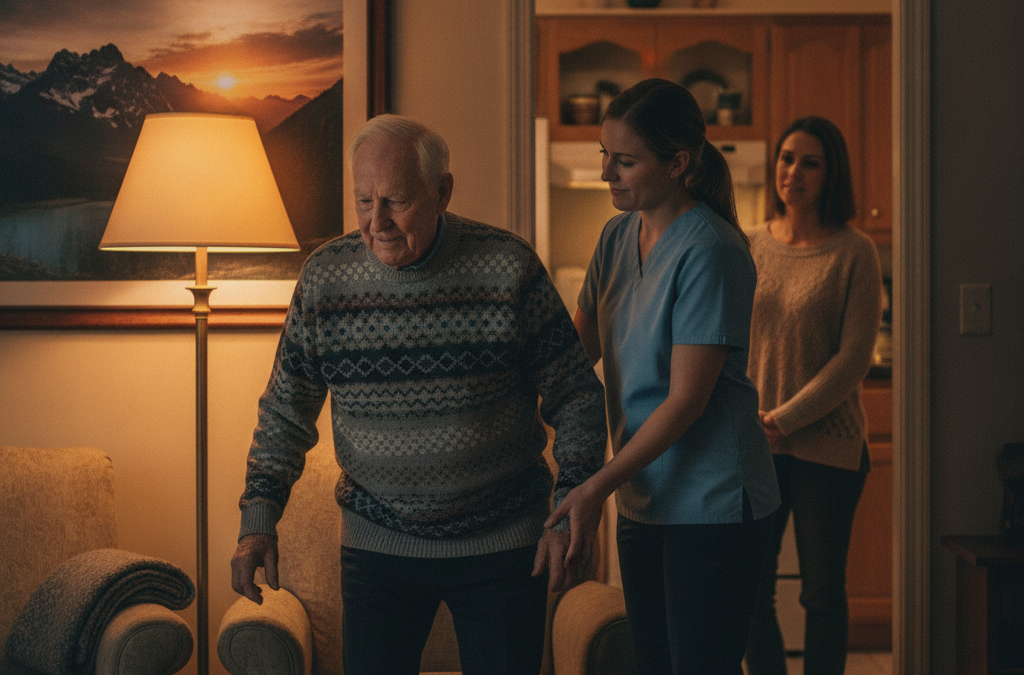
The hospital says your dad can go home Friday — as long as someone’s with him around the clock. You’ve done the mental math on quitting your job. Before you do, here’s what 24-hour home care actually costs in Canada, the two very different ways to buy it, and the tricks families use to make an impossible number survivable.
Straight talk first: full-time paid care at home is the most expensive care arrangement there is. It can absolutely be worth it. But you should see the real numbers before you promise anyone anything.
The Two Models: Rotating Shifts vs. Live-In
“24-hour care” means one of two things, and the price gap between them is enormous:
- Rotating shifts (24/7 hourly): agency caregivers cover the full week in 8- or 12-hour shifts, every hour billed at the hourly rate. Someone is always awake. This is the gold standard for heavy needs — and the eye-watering one.
- Live-in care: one caregiver lives in the home, paid a flat daily rate. They sleep at night (with allowance for occasional help), so it suits seniors who mostly need presence, prompting and daytime support — not hourly nursing through the night.
What 24/7 Hourly Care Costs by Province
At 168 hours a week, private agency rates (2026, personal support level) work out to:
- Ontario ($28–$38/hr): roughly $20,400–$27,700 per month
- Alberta ($28–$50/hr): roughly $20,400–$36,400 per month
- BC ($35–$65/hr): roughly $25,500–$47,300 per month
- Quebec ($40–$55/hr): roughly $29,100–$40,000 per month
Yes, those are monthly figures. Round-the-clock hourly care runs $245,000 to over $400,000 a year at full freight. Almost nobody pays that sticker price for long — which is exactly why the section on cutting the number matters more than this one.
What Live-In Care Costs
Where a live-in arrangement fits the care needs, the math changes completely. Agencies in Ontario and BC typically charge $250–$400 per day for live-in care — about $7,600–$12,200 a month. That’s still serious money, but it’s a third of the rotating-shift bill, and for many families it’s the difference between possible and impossible.
The catch: live-in only works when nights are mostly quiet. If your parent needs hands-on care several times a night, every night, a sleeping caregiver isn’t safe coverage — you’re back to shifts, or it’s time for the harder conversation below.
How Families Actually Make the Number Work
- Claim every public hour first. Ontario Health atHome (310-2222), your BC health authority, Alberta Health Services or your Quebec CLSC can fund assessed home-care hours at no charge. It won’t be 168 hours — but every funded hour comes off the top of the biggest bill you have.
- Cover the gaps, not the clock. Most families don’t buy 24/7 — they buy mornings, evenings and overnights around family coverage. Three paid 8-hour blocks a week plus family is a fraction of the cost.
- Use adult day programs as cheap daytime coverage. Subsidized programs run as little as $10 a day in BC and modestly elsewhere — that’s a full day of supervision, activities and a meal for the price of 20 minutes of agency time.
- Mind the tax side. Attendant care qualifies for the federal Medical Expense Tax Credit, the Disability Tax Credit opens more doors, and Quebec’s home-support credit refunds 39% of eligible costs for 70+. On a five-figure monthly bill, tax recovery is real money.
- In Quebec, hire directly. The new Allocation autonomie à domicile lets CLSC-assessed seniors employ caregivers directly — cutting out agency margins that can double the hourly cost.
The Honest Comparison: When a Facility Costs Less
Long-term care co-payments are capped by every province: Ontario tops out at $3,042 a month for a private room, Alberta continuing care at $2,118–$2,931, Quebec’s CHSLD at $2,242, and BC charges up to 80% of after-tax income with a hard ceiling of $4,142.60.
Read those against the numbers above: true 24/7 hourly care at home costs five to ten times a facility. So here’s the honest framing — if the care need is genuinely round-the-clock and hands-on, home care is a premium you pay for keeping someone in their own home, not the frugal option. Families make that trade with open eyes all the time. Just make it a decision, not a default. And if the need is presence more than nursing, live-in care or a gap-coverage plan keeps aging at home entirely defensible on cost.
Want your own numbers? Our cost of aging in place calculator has an around-the-clock scenario built in — pick your province and see the range, the subsidies you qualify for, and the facility comparison side by side.
Frequently Asked Questions
How much does 24-hour home care cost per month in Canada?
With rotating hourly shifts: roughly $20,000–$47,000 a month depending on province and rates. With a live-in caregiver: roughly $7,600–$12,200 a month. The spread is the single most important thing to understand before calling agencies.
Does OHIP or provincial health care cover 24-hour home care?
No province funds anything close to 24/7 at home. Public programs fund assessed hours — often a handful per week for moderate needs, more for palliative or complex cases. The rest is private pay. That’s why claiming your full public assessment first, then buying gaps, is the standard playbook.
Is 24-hour home care cheaper than a nursing home?
Almost never. Provincial long-term care co-pays cap between about $2,100 and $4,100 a month, while true 24/7 home care runs $20,000+. Live-in care narrows the gap but doesn’t close it. Families choose 24/7 home care for the home, not the savings — and that can be a completely valid choice.
What does overnight care alone cost?
An overnight shift (typically 10–12 hours) at provincial hourly rates runs roughly $280–$780 a night depending on province and whether the caregiver is awake all night or on a sleep shift. If you only need nights covered, buy nights — not the whole clock.
Can family members be paid to provide the care?
Sometimes. Quebec’s AAD can formally employ family caregivers under CLSC conditions. Other provinces have narrower self-managed-care routes, and the federal caregiver tax credits offer partial recognition either way. Ask your provincial home-care coordinator what applies before assuming the answer is no.