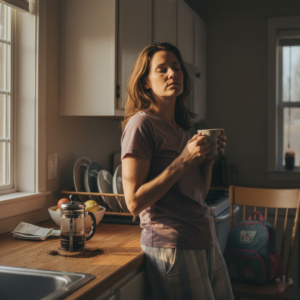
You spent two hours explaining to the pharmacist why your mom needs this specific medication — again. Then you drove home, heated up her dinner, helped her to bed, cleaned the kitchen, and sat down at 10pm with a glass of wine and zero people to talk to who understand what your life looks like right now.
Your friends try. But when you say “Mom thought I was a stranger today” and they say “That must be hard,” you want to scream. They don’t get it. They can’t. Not unless they’ve lived it.
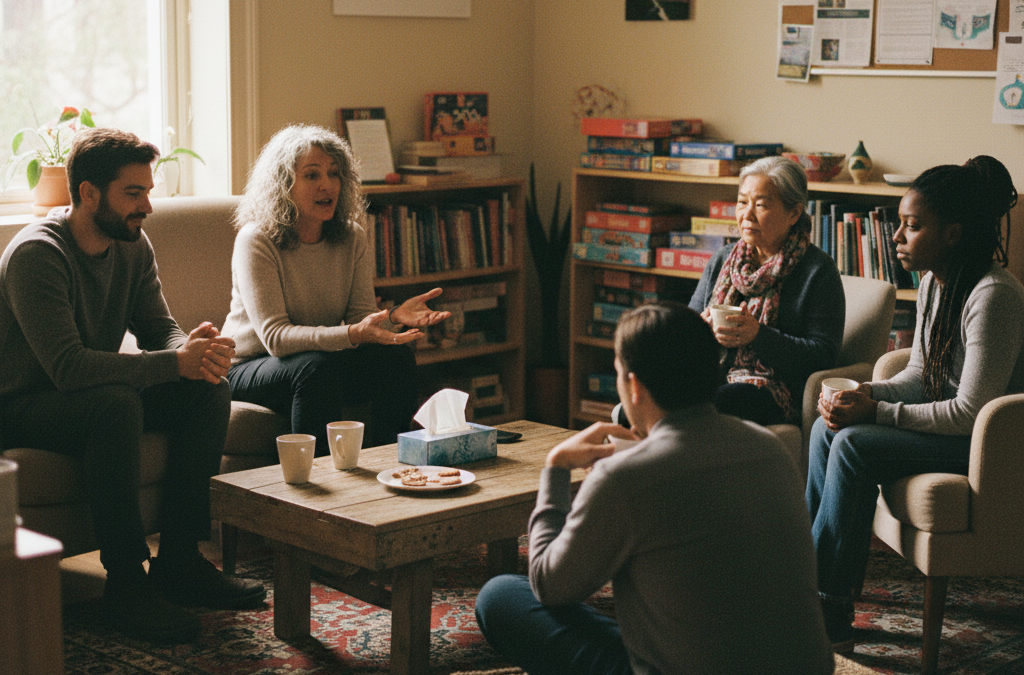
That’s what caregiver support groups are for. Not therapy (though you might need that too). Not advice from professionals who’ve read textbooks. A room — physical or virtual — full of people who are living your exact life. Who nod when you talk because they’ve been there at 3am too.
What’s in This Guide
Why Support Groups Actually Work
It’s not just talking. Research shows caregiver support groups measurably reduce depression, anxiety, and feelings of isolation. A 2023 Canadian study found that caregivers who attended regular support groups reported 30% lower rates of clinical depression compared to those who didn’t.
Here’s what you get that you can’t get anywhere else:
- Validation. “Yes, that’s normal. Yes, it’s that hard. No, you’re not failing.”
- Practical tips from people who’ve tried everything. Not theoretical advice — real solutions that real families have tested. “Here’s how I got my dad to take his medication.” “Here’s the trick for sundowning.”
- Permission to feel what you feel. Anger, resentment, grief, dark humour — things you can’t say to friends or family without being judged.
- Information about resources you didn’t know existed. Other caregivers are your best source of “I found this program” or “this agency was good.”
- A break from being the strong one. For one hour a week, you don’t have to hold it together.
Types of Caregiver Support Groups
Condition-specific groups
For caregivers dealing with a specific diagnosis — Alzheimer’s/dementia, Parkinson’s, stroke, ALS, etc. These are the most useful because the challenges are specific. Caring for someone with dementia and sundowning is a completely different experience from caring for someone recovering from a stroke.
General caregiver groups
Open to all family caregivers regardless of the care recipient’s condition. Good if there’s no condition-specific group in your area, or if your caregiving challenges are more about the emotional toll than the medical specifics.
Online/virtual groups
Zoom meetings, Facebook groups, forums. Essential for caregivers who can’t leave the house or live in rural areas. The Alzheimer Society runs virtual support groups nationwide.
Professionally facilitated vs peer-led
Some groups are led by social workers or counsellors. Others are run by caregivers themselves. Both have value — professional groups offer structure and clinical knowledge; peer groups offer rawer, more personal connection.
Where to Find Support Groups in Canada
National organizations
- Alzheimer Society of Canada — the largest network. Support groups in every province. Their First Link program specifically connects newly diagnosed families. Call 1-855-705-4636 or visit their website to find a local chapter.
- VON Canada (Victorian Order of Nurses) — offers caregiver support programs in several provinces.
- Parkinson Canada — support groups specifically for Parkinson’s caregivers.
- Canadian Cancer Society — caregiver support when the care recipient has cancer.
- Heart & Stroke Foundation — programs for stroke caregivers.
Provincial resources
- Ontario: Ontario Caregiver Organization — connects caregivers with local support. Also check your local Home and Community Care Support Services.
- Quebec: L’Appui pour les proches aidants — Quebec’s dedicated caregiver support network. French-language groups widely available.
- British Columbia: Family Caregivers of BC — information, support groups, education programs.
- Alberta: Caregivers Alberta — support programs and peer groups across the province.
Local options
- Hospitals and health centres — many run caregiver groups, especially those with geriatric or palliative care programs.
- Community health centres
- Faith communities — churches, mosques, synagogues, temples often host caregiver groups.
- Senior centres — some offer caregiver-specific programming alongside their senior programs.
Online Options (For When You Can’t Leave the House)
If you can’t leave your parent — or you live in a rural area — these work:
- Alzheimer Society virtual support groups — free, facilitated, available across Canada. Check your local chapter’s calendar.
- Caregiver Action Network — US-based but active online community with Canadian members.
- Facebook groups — search for “Canadian caregiver support” or condition-specific groups. These are unmoderated so quality varies, but the 24/7 availability is invaluable at 3am.
- Caregiving.com forums — long-running community with active discussions.
The best online group is one with active members who respond. Lurk for a week before committing — you’ll quickly see which groups are supportive and which are toxic.
What to Expect at Your First Meeting
You’ll be nervous. Everyone is. Here’s what typically happens:
- Introductions. You say your name and briefly who you’re caring for. You don’t have to share anything else until you’re ready.
- People share. Someone talks about their week. Others respond. There’s often crying. There’s often laughter. Sometimes in the same sentence.
- You listen. At your first meeting, just listening is enough. You’ll hear your own story reflected in someone else’s — and that alone is powerful.
- Nobody judges. You can say “I hate this” or “I’m angry at my mom” or “I thought about not going home” and people will nod, not gasp.
- You leave feeling lighter. Not fixed. Not solved. But lighter. Because for one hour, you weren’t alone in this.
Important: If the first group isn’t right for you, try another. Groups have personalities. Finding the right fit sometimes takes two or three tries. Don’t give up after one.
Frequently Asked Questions
I don’t like group settings. Is there an alternative?
Yes — individual counselling with a therapist who specializes in caregiver issues. Many provinces cover this through public health. You can also try online forums if real-time groups feel too exposed. Some people find one-on-one peer matching (through the Alzheimer Society’s First Link) more comfortable than groups.
I don’t have time for a support group.
If you don’t have time for one hour a week, that’s precisely why you need a support group. This is a burnout signal. Many groups meet virtually in the evening (8-9pm after your parent is in bed). Some meet monthly, not weekly. Start with what’s possible.
Will a support group fix my situation?
No. Your situation stays the same. What changes is how you carry it. You’ll have tools, perspective, and people who get it. That doesn’t sound like much until you’ve been carrying everything alone.
Are support groups free?
Almost always. Groups run by the Alzheimer Society, hospitals, community centres, and faith communities are free. Some private therapy groups charge a fee. If cost is a barrier, start with the free options — there are plenty.
My parent has dementia. Should I join a dementia-specific group?
Yes, strongly recommended. Sundowning, hallucinations, wandering, personality changes — these are unique to dementia caregiving. A general caregiver group may not understand. The Alzheimer Society runs dementia-specific caregiver groups in every province.
Caring for an aging parent? You don’t have to do it alone. Find home care, respite care, and support services across Canada at AgePlaceHub.