
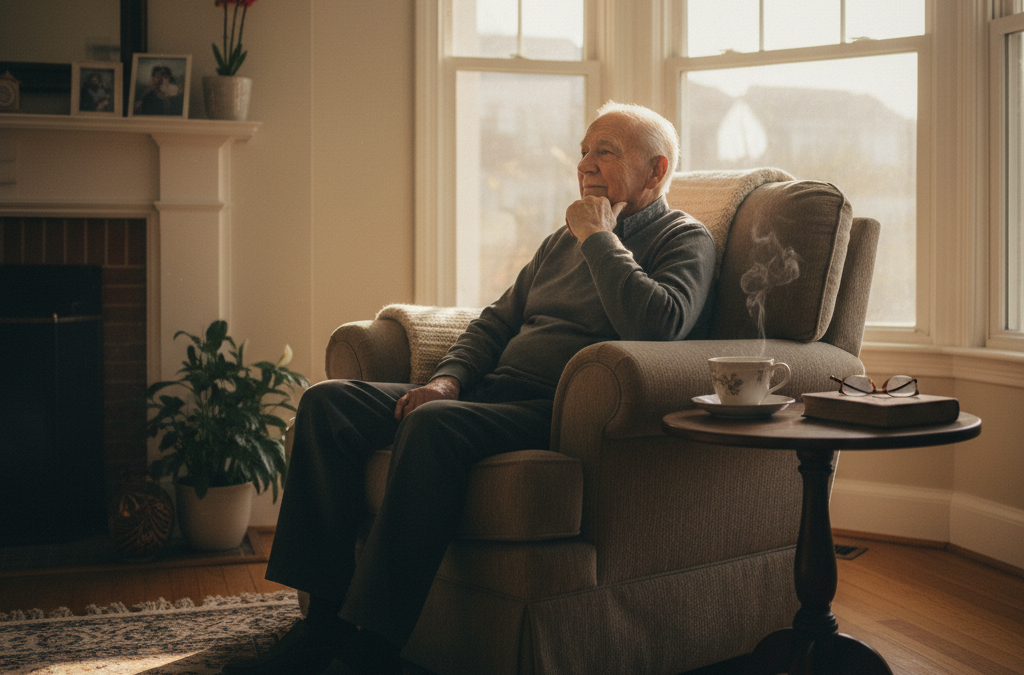
Your mom used to be the one who organized the neighbourhood potluck. She knew everyone’s birthday, kept the conversation going at family dinners, and never missed a Sunday phone call with her sister in Winnipeg. Now she sits in her living room for hours, the television on but unwatched, the phone silent on the counter. When you visit, she says she’s fine. But you can see it — something has gone quiet inside her.
If this sounds familiar, you are not alone. And neither is what your parent is going through, even though loneliness is exactly what makes it feel that way.
The Scope of Senior Loneliness in Canada
According to the National Institute on Ageing at Toronto Metropolitan University, nearly one in five older Canadians — roughly 1.4 million people — report feeling lonely. Among those living alone, the numbers climb higher. Statistics Canada data shows that seniors who live by themselves are more than twice as likely to report frequent feelings of loneliness compared to those who live with others.
These are not just numbers. Each one represents a person who once had a full life — a career, friendships, a daily rhythm that gave their days shape and meaning. Retirement, the death of a spouse, declining mobility, and the quiet drift of adult children into their own busy lives can strip all of that away, one layer at a time.
What makes senior loneliness particularly cruel is how invisible it can be. Your father might still answer the phone cheerfully. Your mother might insist she doesn’t need anything. Pride and a lifetime of self-reliance make it very hard for older adults to say the words: I am lonely.
Why Loneliness Is a Health Crisis, Not Just an Emotion
Loneliness is not simply feeling sad. Research has shown that chronic social isolation carries health risks comparable to smoking 15 cigarettes a day. That statistic, first published by Dr. Julianne Holt-Lunstad at Brigham Young University, has been confirmed by multiple studies since. It is not an exaggeration — it is a medical reality.
The health consequences of prolonged loneliness in older adults include:
- Cardiovascular disease: Lonely seniors face a 29% increased risk of heart disease and a 32% increased risk of stroke, according to a meta-analysis published in the journal Heart.
- Cognitive decline and dementia: Social isolation is associated with a 50% increased risk of developing dementia. The brain, like any muscle, needs engagement to stay healthy.
- Depression and anxiety: Loneliness and depression feed each other in a vicious cycle. A lonely person withdraws further, which deepens the loneliness, which worsens the depression.
- Weakened immune function: Chronic loneliness triggers a stress response in the body that suppresses the immune system, making seniors more vulnerable to infections and slower to heal.
- Increased mortality: Multiple studies have found that socially isolated seniors have a significantly higher risk of premature death — on par with obesity and physical inactivity.
When we talk about keeping our parents healthy, we often think about medications, doctor’s appointments, and fall prevention. But connection is a health intervention. It belongs on the same list.
How COVID Made Everything Worse
The pandemic did not create senior loneliness, but it poured gasoline on a fire that was already burning. Lockdowns, visitor restrictions in long-term care homes, cancelled community programs, and the fear of a virus that disproportionately killed older adults created a period of enforced isolation that many seniors have never fully recovered from.
In Canada, the impact was devastating. A 2021 report from the Canadian Institute for Health Information found that residents in long-term care homes experienced severe declines in mental health during the pandemic, with rates of depression symptoms increasing sharply. Community-dwelling seniors lost access to the informal social networks — coffee with friends, church groups, library visits — that had been quietly sustaining them for years.
Even as restrictions lifted, many older adults did not return to their previous routines. The confidence to go out had eroded. Friends they used to see had moved, declined in health, or passed away. The world had shifted, and for many seniors, the path back to connection was no longer clear.
Three years later, the social infrastructure that once supported older Canadians is still being rebuilt. And for families, the question remains: how do I help my parent find their way back?
Warning Signs That Your Parent May Be Struggling
Because lonely seniors rarely announce their loneliness, it falls to the people who love them to recognize the signs. Watch for these changes:
- Withdrawal from activities they once enjoyed — skipping church, dropping out of a book club, no longer going for walks
- Changes in eating habits — losing weight, not cooking, letting food expire in the fridge
- Increased television or screen time — using the TV as a companion rather than entertainment
- Sleep disturbances — sleeping far too much or struggling with insomnia
- Decline in personal care — not showering regularly, wearing the same clothes for days
- Increased irritability or negativity — loneliness can show up as anger, not sadness
- Clinging to phone calls or visits — not wanting you to leave, calling multiple times a day
- Hoarding or excessive shopping — sometimes a way to fill an emotional void
- New or worsening health complaints — frequent doctor visits can be a way to seek human contact
None of these signs on their own is cause for alarm. But a pattern — especially one that has developed gradually over months — deserves your attention.
A Word About Guilt
If you are reading this article, there is a good chance you are already carrying guilt. The thought that circles in your head at 2 a.m.: I should visit more. I should call more. I’m a bad daughter. I’m a bad son.
Let’s be honest about this. You probably should visit more. Most of us should. But guilt is not a strategy, and it is not a sustainable fuel for caregiving. You have a job, maybe children of your own, a relationship that needs tending, and a life that makes constant demands on your time and energy. The answer to your parent’s loneliness is not you, alone, trying to be everything.
The answer is building a web of connection around your parent — one that includes you, but does not depend entirely on you. That is not a failure of love. That is wisdom. And it is what your parent would want for you if they could step outside their own need long enough to say so.
If you are also managing the emotional weight of caregiving from a distance, our guide on caregiver burnout may help you understand why you feel the way you do — and what to do about it.
Practical Solutions: Building Connection Back Into Your Parent’s Life
There is no single fix for loneliness. What works depends on your parent’s personality, mobility, location, and willingness to try something new. Here are the most effective approaches, starting with the ones that require the least from your parent and building toward greater independence.
1. Companion Care and Home Visitors
For seniors who are homebound or resistant to going out, bringing connection to them is the first step. Home care services across Canada offer companion care — a trained caregiver who visits regularly not to provide medical care, but simply to be present. They might share a cup of tea, play cards, help with a puzzle, or go for a short walk together.
This is not a luxury. For an isolated senior, a weekly companion visit can be the difference between spiralling further into depression and beginning to re-engage with life.
Several provinces also fund volunteer visitor programs through organizations like the Victorian Order of Nurses (VON) and local community health centres. These programs match volunteers with isolated seniors for regular visits — often weekly — at no cost to the family.
2. Community Centres and Senior Day Programs
Community centres remain one of the most underused resources for combating senior loneliness. Most Canadian cities and towns offer programming specifically for older adults: exercise classes, art workshops, lunch programs, card games, and social drop-ins.
Senior day programs take this a step further, offering structured full- or half-day programming that includes meals, activities, and socialization. For seniors with mild cognitive impairment, adult day programs provide stimulation and companionship in a supervised setting — and they give family caregivers much-needed respite.
The biggest barrier is often the first visit. Your parent may say they don’t want to go, that it’s “not for them,” or that they don’t know anyone there. This is the loneliness talking. Offer to go with them the first time. Drive them, walk them in, stay for the first half-hour. Sometimes all it takes is one positive experience to break the cycle.
3. Technology and Video Calls
Technology is not a replacement for in-person connection, but for families spread across this enormous country, it can be a lifeline. A tablet set up with a simplified interface, pre-loaded with video calling apps, can allow a grandparent in Halifax to see their grandchild’s face in Calgary every Sunday.
The key is making the technology as simple as possible. Consider:
- A dedicated tablet with only the apps they need, in large-icon mode
- Scheduled video calls at the same time each week — routine is everything for older adults
- Photo-sharing apps where family members can post pictures your parent can browse throughout the day
- Smart displays (like the Amazon Echo Show or Google Nest Hub) that allow voice-activated calling
Do not assume your parent cannot learn. Many seniors who resisted technology during the pandemic eventually adopted it and found genuine comfort in it. Patience, repeated teaching, and a written cheat sheet go a long way.
4. Senior Social Groups and Clubs
Across Canada, organizations like the Royal Canadian Legion, faith communities, Men’s Sheds, and women’s groups offer structured social opportunities for older adults. These groups work because they are built around a shared purpose — not just socializing for its own sake, but doing something together.
For men in particular, who often struggle more with social isolation after retirement, Men’s Sheds (a movement that originated in Australia and has grown in Canada) provide a workshop space where men can work on projects side by side. The conversation happens naturally, without the pressure of face-to-face social settings that many older men find uncomfortable.
Your local 211 helpline (available across Canada by dialing 2-1-1) can connect you with social programs for seniors in your community. It is one of the most valuable and underused resources in the country.
5. Intergenerational Programs
Some of the most effective loneliness interventions pair seniors with younger people. Intergenerational programs — where older adults read to schoolchildren, mentor young people, or participate in shared activities with students — have been shown to improve mood, cognitive function, and sense of purpose in older participants.
In Canada, organizations like iGen and various school-based programs are expanding these opportunities. If your parent has a skill, a story, or simply a willingness to be present with young people, this kind of connection can be transformative for both generations.
6. Pet Companionship
The evidence on pets and loneliness is clear: animal companionship reduces feelings of isolation, lowers blood pressure, and provides a reason to get up in the morning. For seniors who are able to care for a pet, adoption can be life-changing. For those who cannot manage full-time pet ownership, programs like pet therapy visits and shelter volunteer opportunities offer animal connection without the daily responsibility.
Starting the Conversation
Talking to your parent about loneliness requires gentleness. Do not say “You seem lonely” — that can feel like an accusation. Instead, try:
- “I noticed you haven’t been to the seniors’ centre lately. What changed?”
- “I worry about you being on your own so much. Not because you can’t handle it — I just want to make sure you’re enjoying your days.”
- “I found a program that sounded interesting. Would you be open to checking it out together?”
- “I know things have been different since Dad passed. I want to help, and I don’t always know how.”
Listen more than you talk. Acknowledge what they have lost. Do not rush to fix. Sometimes the most important thing is simply letting your parent know that you see them — really see them — and that their loneliness matters to you.
What Communities and Policymakers Must Do
While families carry much of the burden, senior loneliness is a public health issue that demands a public response. Canada’s National Seniors Strategy has identified social isolation as a priority, but funding for community-based programs remains inconsistent across provinces.
What is needed is not complicated:
- Sustained funding for community centres, day programs, and outreach workers who can identify and visit isolated seniors
- Transportation solutions — many seniors are isolated not because programs don’t exist, but because they cannot get to them
- Training for healthcare providers to screen for loneliness as routinely as they screen for depression or falls risk
- Housing that fosters connection — co-housing models, intergenerational buildings, and neighbourhood designs that make it easy for older adults to encounter other people in their daily lives
Until those systemic changes happen, the work falls to families, volunteers, and communities. It is not fair. But it is where we are.
You Cannot Fix Loneliness Alone — But You Can Make a Difference
If your parent is lonely, you cannot wave a magic wand and fill their days with meaning and companionship. But you can take one step today. One phone call to a community centre. One conversation about a day program. One scheduled video call that you protect the way you would protect a work meeting — because it is just as important.
You can also forgive yourself for not being able to do more. Your parent raised you to have your own life. Living it is not a betrayal. Loving them from within the honest limits of your time and energy is not a failure. It is the most human thing there is.
The opposite of loneliness is not constant company. It is the feeling of being known, of mattering to someone, of having a reason to get dressed in the morning. You can help your parent find that — not by doing everything, but by refusing to do nothing.
Start today. Call them. And then help them build the connections that will carry them through the days when you cannot be there.