
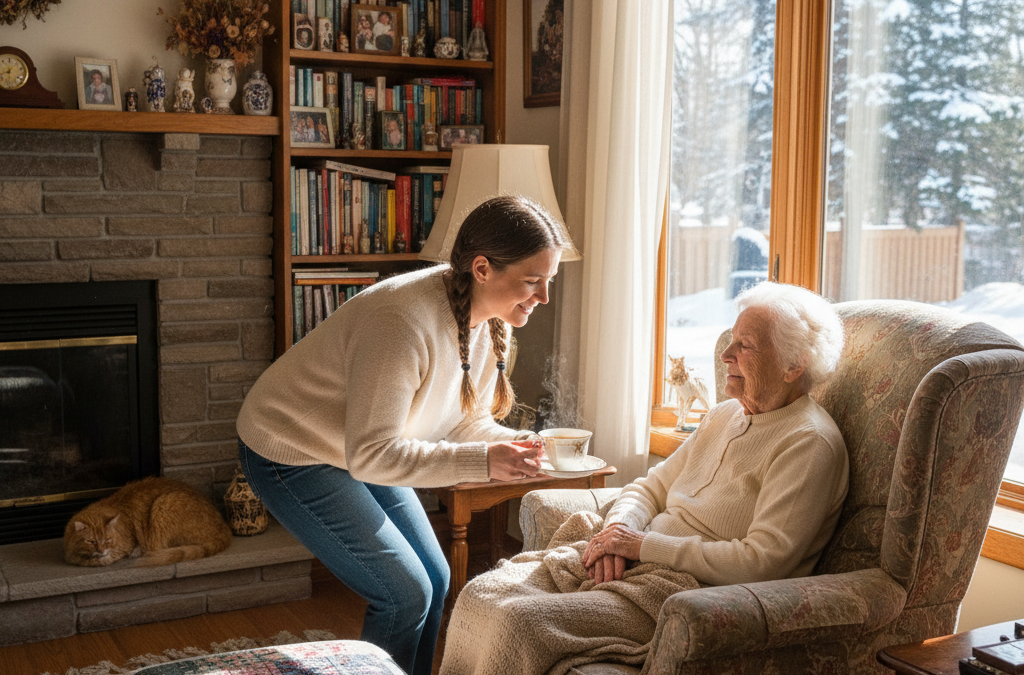
You haven’t slept through the night in four months. You can’t remember the last time you left the house for something that wasn’t a pharmacy run or a doctor’s appointment. Your back hurts from transfers. Your patience is thinner than it’s ever been. And the guilt — the guilt of even thinking about needing a break — sits on your chest like a weight.
If this sounds familiar, you’re not lazy. You’re not failing. You’re a caregiver who needs respite. And in-home respite care exists specifically for people in your situation.
This guide explains what respite care actually is, how to get it (including what Ontario and other provinces will pay for), and why taking a break isn’t abandoning your loved one — it’s the only way to keep going.
What Is In-Home Respite Care?
Respite care means someone else takes over caregiving duties so you can step away. That’s it. No complicated medical definition. A trained caregiver comes to your loved one’s home — or your home, if that’s where they live — and provides the same support you’ve been providing: meals, medication reminders, personal care, companionship, supervision.
The “in-home” part matters. Your loved one stays in their own environment, in their own bed, with their own routine. For people with dementia especially, this is huge. Moving them to an unfamiliar facility — even for a few days — can cause confusion and agitation that takes weeks to recover from.
In-home respite can look like:
- A few hours on a Tuesday afternoon so you can go to your own doctor’s appointment (when was the last time you did that?)
- An overnight stay so you can actually sleep without one ear listening for sounds down the hall
- A full weekend so you can visit your other family members, attend a wedding, or just sit in a quiet room and do nothing
- Regular weekly sessions — say, every Wednesday — so you have something consistent on the calendar that’s yours
There’s no minimum or maximum. You use what you need, when you need it.
Who Provides In-Home Respite Care?
Three main options, each with trade-offs:
1. Government-Funded Respite (Through Ontario Health atHome)
If you’re in Ontario, call 310-2222. Ask specifically about caregiver respite — don’t just ask about “home care,” because the intake worker may only discuss services for the care recipient, not for you.
What you can get:
- PSW visits specifically designated as respite (separate from your loved one’s regular care hours)
- Typically 4 to 12 hours per week, depending on your situation and what’s available
- No cost — this is OHIP-funded
The catch: wait times. You might wait 2 to 6 weeks for an assessment, and then additional weeks before a PSW is actually assigned. The OHIP home care system is stretched thin, and respite hours are often the first thing that gets delayed when there aren’t enough workers. If you’re in crisis now, don’t rely on this as your only plan.
2. Private Home Care Agencies
This is the faster option. Most private home care agencies can have someone at your door within 48 hours, sometimes the same day. You’re paying out of pocket — expect $28 to $45 per hour depending on your city and the level of care needed.
The advantage: you choose the schedule, you can request the same caregiver every time, and there’s no waitlist. The disadvantage: it adds up fast. A 6-hour respite session once a week costs $170 to $270. Over a month, that’s $680 to $1,080 — real money for most families.
If cost is a barrier, read the section below on tax credits and subsidies. Most families leave money on the table because they don’t know what’s available.
3. Independent PSWs
Hiring a personal support worker directly — not through an agency — is the most affordable option. Independent PSWs typically charge $18 to $25 per hour, about half what agencies charge. The trade-off is that you’re the employer: you handle scheduling, backup coverage when they’re sick, and technically you should be remitting CPP and EI.
Where to find them: community Facebook groups, PSW college job boards, word of mouth from other caregivers, or your local community health centre. Some families find excellent, reliable PSWs this way. Others cycle through several before finding the right fit. If you’re already exhausted, the hiring process itself can feel like another burden — be honest with yourself about whether you have the bandwidth for it.
The Real Reason Most Caregivers Don’t Use Respite
It’s not money. It’s not availability. It’s guilt.
Every caregiver I’ve spoken to says some version of the same thing: “Nobody can care for them the way I do.” And you know what? You might be right. A respite worker might not know that your dad likes his tea at exactly 3:15, or that your mom gets anxious if the living room light isn’t on before sunset.
But here’s what happens without breaks: you burn out. And caregiver burnout doesn’t look like what you’d expect. It’s not dramatic. It’s slow. It’s shorter temper. Less patience with the person you love. Resentment you’re ashamed of. Mistakes with medications because you’re running on four hours of sleep. Health problems you ignore because you “don’t have time” to see your own doctor.
The research on this is clear. Caregivers who use respite regularly:
- Provide care for longer before needing to consider a long-term care home
- Report better relationships with the person they’re caring for
- Have measurably lower rates of depression and anxiety
- Make fewer emergency room visits themselves
Taking a break isn’t selfish. It’s maintenance. You wouldn’t drive a car for 50,000 kilometres without an oil change and then act surprised when the engine seizes. Your body and mind work the same way.
How Much Does In-Home Respite Care Cost?
Here’s a realistic breakdown for 2026:
- Government-funded (Ontario Health atHome): Free, but limited hours and long wait times
- Private agency PSW: $28–$45/hour. A typical 4-hour visit costs $112–$180
- Independent PSW: $18–$25/hour. Same 4-hour visit costs $72–$100
- Overnight respite (8–12 hours): $200–$450 through an agency, $144–$300 independently
- Weekend respite (48 hours): $800–$1,800 depending on care level and provider
These costs vary significantly by city. Toronto and Vancouver are at the top of the range. Smaller cities in Ontario and the Prairies tend to be 15–20% cheaper.
Funding and Tax Credits That Offset the Cost
This is the part most families miss entirely. There is money available — you just have to know where to look and actually claim it.
Ontario Caregiver Respite Programs
Beyond Ontario Health atHome, several community organizations offer funded respite hours. The Alzheimer Society chapters across Ontario provide respite programs specifically for dementia caregivers — some at no cost. Your local Community Health Centre may also have respite programs. These are not well-advertised. You have to call and ask.
Ontario Seniors Care at Home Tax Credit
A refundable provincial tax credit — meaning you get the money even if you owe zero tax. It covers 25% of eligible medical expenses (including respite care) up to $6,000, for a maximum credit of $1,500 per year. The senior must be 70+ with income under approximately $65,000. This one credit alone can cover a month and a half of weekly respite sessions. Details in our tax credits guide.
Canada Caregiver Credit (Federal)
A non-refundable federal credit worth up to $8,773 if you’re supporting an infirm dependant. Your loved one needs to have a physical or mental impairment confirmed by a medical practitioner. This isn’t specifically for respite care — it’s for being a caregiver, period. But it puts money back in your pocket that you can direct toward respite.
Medical Expense Tax Credit (Federal)
Respite care qualifies as a medical expense if the care recipient has a disability or impairment. You can claim attendant care costs that exceed $2,759 (or 3% of your net income, whichever is less). At a 15% credit rate, $5,000 in respite expenses would save you roughly $336 in federal tax. Not life-changing on its own, but it stacks with the other credits.
Veterans Affairs Canada
If your loved one is a veteran, VAC offers a caregiver recognition benefit of $1,264.25 per month (tax-free, 2026 rate) plus access to funded respite care. This is one of the most generous programs available and is chronically underused. Call VAC directly — the eligibility criteria are broader than most people assume.
Stacking Everything Together
A realistic example: You spend $200/week on private respite care ($10,400/year). Between the Ontario Seniors Care at Home Credit ($1,500), the Canada Caregiver Credit (tax savings of ~$1,300), and the Medical Expense Tax Credit (~$700), you recover approximately $3,500 — bringing your effective annual cost down to about $6,900, or $133/week. Still not cheap, but significantly more manageable.
Respite Care for Dementia Caregivers
Dementia caregiving is a different animal. The physical demands are real, but it’s the emotional toll that breaks people — watching your parent not recognize you, repeating the same conversation fifteen times a day, managing aggression or wandering behaviour that makes it unsafe to look away for five minutes.
If you’re caring for someone with dementia at home, respite isn’t optional. It’s essential. Here’s what to know:
- Request a dementia-trained respite worker. Not all PSWs have specific dementia training. When booking through an agency, ask explicitly. A worker who doesn’t understand sundowning or redirection techniques will call you back within an hour.
- Start respite before you’re desperate. The worst time to introduce a new person into a dementia patient’s home is when you’re already in crisis. Start with short, regular visits early — even when you feel like you can still handle everything — so your loved one gets used to another face.
- Contact the Alzheimer Society. Every province has local chapters that offer subsidized or free respite programs, caregiver support groups, and day programs. In Ontario, call the Alzheimer Society of Ontario at 1-800-879-4226. These programs exist because people like you need them.
- Consider adult day programs as a complement. While not in-home, adult day programs give you 6–8 hours of daytime respite while your loved one participates in structured activities in a safe environment. Many are subsidized. They work well alongside in-home evening or weekend respite.
How to Make Respite Care Work (Practical Tips)
The first respite session is almost always awkward. Your loved one may resist. You may hover by the phone the entire time. That’s normal. Here’s how to make it work:
Prepare the Respite Worker
Write down everything. Not just medications and allergies — the real stuff. What time they like to eat. What TV shows they watch. What topics upset them. How they like their coffee. Whether they need the bathroom light on at night. A one-page cheat sheet makes the difference between a respite worker who’s guessing and one who’s confident.
Start Small
Don’t book a full weekend for your first respite session. Start with 3–4 hours. Stay nearby (a coffee shop, not the house) so you’re reachable but not hovering. Build up gradually. By the third or fourth session, most care recipients have adjusted to the routine.
Request the Same Worker
Consistency matters enormously, especially for seniors with cognitive decline. Whether you’re using an agency or an independent PSW, insist on the same person each time. If the agency can’t guarantee that, find a different agency. Rotating strangers through your loved one’s home is stressful for everyone.
Actually Leave
This is the hardest part. The point of respite is for you to rest. Don’t spend the time doing laundry or catching up on paperwork. Go for a walk. See a friend. Sit in a park. Sleep. Do something that has absolutely nothing to do with caregiving. You’ll come back better for it.
Other Types of Respite Care
In-home respite is the focus of this guide, but it’s worth knowing about other options that might work for your situation:
- Adult day programs: Your loved one attends a supervised program during the day (typically 9 AM to 3 PM). Cost ranges from $30 to $80/day, and many are subsidized. Good for socialization and for caregivers who work.
- Short-stay facility respite: Some long-term care homes and retirement homes offer temporary stays of 1 to 4 weeks. Useful for when you need extended time — a vacation, surgery recovery, or just a longer break. Costs $100 to $250/day depending on the facility.
- Overnight respite in the home: A step up from daytime visits. The respite worker stays overnight to handle nighttime needs — toileting, repositioning, wandering supervision. Essential for caregivers who haven’t slept properly in months.
- Virtual respite / companion calls: Newer services offer scheduled video calls with trained companions who engage your loved one in conversation, reminiscence activities, or cognitive exercises. Not a replacement for in-person care, but useful as a supplement — and usually under $20/session.
Respite Care by Province
Every province has publicly funded respite options, but they’re administered differently and the generosity varies significantly.
Ontario
Through Ontario Health atHome (310-2222). Respite hours are part of the home care program. Also look into the Ontario Caregiver Organization (ontariocaregiver.ca) for peer support and program navigation help.
British Columbia
Through your local Health Authority. BC offers respite care as part of its Home and Community Care program. Eligible clients may receive in-home respite, adult day programs, or short-stay facility respite. Contact your Health Authority’s home health office or call 8-1-1. For a broader look at BC programs, see our guide to government benefits for seniors in BC.
Alberta
Through Alberta Health Services Continuing Care. Respite options include in-home support, day programs, and facility-based overnight respite. Call the Continuing Care Access line at 1-855-371-4122.
Manitoba
Through your Regional Health Authority. Manitoba’s Home Care Program includes respite as a core service. Contact your local RHA or call Manitoba Health Links at 204-788-8200 (Winnipeg) or 1-888-315-9257.
Saskatchewan, Atlantic Provinces, and Territories
Each has home care programs that include some respite hours. Availability and wait times vary. Start with your family doctor or call your provincial 8-1-1 health line to request a home care assessment that includes respite needs.
When Respite Care Isn’t Enough
Sometimes respite care is a band-aid on a wound that needs stitches. If you’re using respite just to survive week to week, and the gaps between sessions feel unbearable, it may be time to have a harder conversation about long-term care or a retirement home.
That’s not giving up. It’s recognizing that your loved one’s needs have outgrown what one person — or even one person plus a few hours of respite — can safely provide. Many families describe the move to residential care as the moment they could finally be a daughter or son again, instead of a full-time nurse.
If you’re not ready for that conversation yet, that’s okay too. Use respite. Use it regularly. Use it without guilt. You’ve earned it.
Find Respite and Home Care Providers Near You
Ready to arrange respite care? Browse providers in your area:
- Home care providers in Toronto
- Home care providers in Ottawa
- Home care providers in Vancouver
- Home care providers in Calgary
- Home care providers in Winnipeg
- Home care providers in Hamilton
- Home care providers in Mississauga
- Browse all providers across Canada