
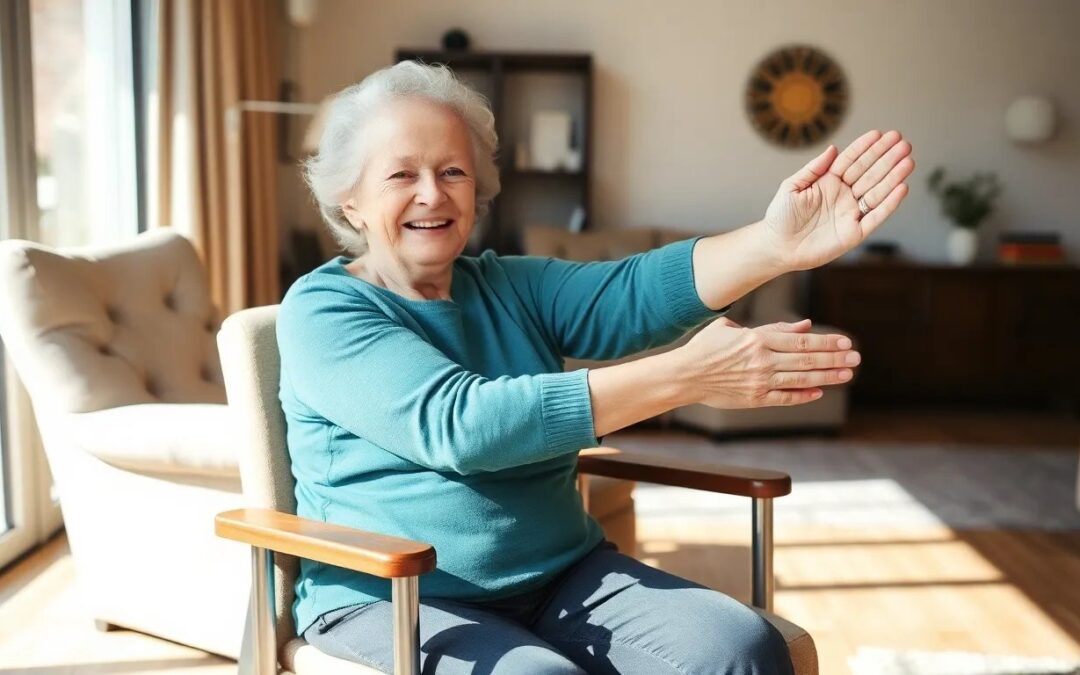
You Don’t Need to Stand Up to Get Stronger
Maybe your knees don’t cooperate anymore. Maybe your balance isn’t what it used to be, and getting down on the floor feels like a one-way trip. Maybe you use a wheelchair or a walker, and every “senior fitness” video you’ve found assumes you can stand for 30 minutes straight.
None of that matters here. Chair exercises for seniors are real exercise. They build strength, improve flexibility, reduce pain, and help you stay independent longer. All you need is a sturdy chair and 20 minutes.
This isn’t a watered-down workout. It’s a complete daily routine designed for people who feel safest sitting down — and there’s zero shame in that. Whether you’re a senior looking to stay active, or a caregiver helping a parent move more, this guide gives you every exercise, step by step, with exact reps and breathing cues.
If you’re looking for the bigger picture on staying active as you age, our complete guide to exercises for seniors covers everything from walking programs to strength training.
What You Need to Get Started
Almost nothing. That’s the beauty of seated exercises for seniors — the barrier to entry is about as low as it gets.
- A sturdy chair without wheels. A kitchen or dining chair works perfectly. It should have a firm seat and a solid back. Avoid rolling office chairs, recliners, or anything with cushions so deep you sink into them. If you use a wheelchair, lock the brakes before starting.
- Comfortable clothing. Nothing tight around the chest or waist. Shoes with non-slip soles, or bare feet on a non-slip surface.
- A water bottle. Stay hydrated. Take sips between exercises. Bonus: two full water bottles double as light hand weights.
- Optional: a resistance band. A light or medium resistance band adds challenge to upper body exercises. You can find them at any dollar store or pharmacy for under $10. Not required — every exercise below works without one.
That’s it. No gym. No equipment. No special space. Your living room, kitchen, or even a sunny spot on the patio works fine.
Warm-Up: Wake Up Your Joints (2 Minutes)
Never skip the warm-up. Cold muscles and stiff joints are more prone to strain. These four movements gently increase blood flow and loosen you up.
1. Seated March in Place
Sit tall with your feet flat on the floor, hip-width apart. Lift your right knee a few inches off the chair, then lower it. Repeat with the left knee. Alternate back and forth at a comfortable pace — like a slow march.
Do 20 total (10 each side). Breathe naturally. This gets blood moving to your legs and warms up your hip flexors.
2. Shoulder Rolls
Let your arms hang relaxed at your sides. Roll both shoulders forward in a big, slow circle — up toward your ears, back, and down. Do 5 forward, then reverse direction and do 5 backward.
10 total. Move slowly. You should feel the tension in your upper back start to release.
3. Neck Side Tilts
Gently tilt your right ear toward your right shoulder. Hold for 3 seconds. Return to centre. Repeat on the left side. Don’t force it — just go until you feel a gentle stretch along the side of your neck.
Do 4 total (2 each side). Keep your shoulders down and relaxed the entire time.
4. Ankle Circles
Lift your right foot slightly off the floor. Slowly draw a circle with your toes — 5 circles clockwise, then 5 counter-clockwise. Switch to the left foot and repeat.
20 total (10 each foot). This loosens up ankles that tend to stiffen from sitting.
Upper Body Seated Exercises
These six exercises target your arms, shoulders, chest, and upper back. Strong upper body muscles make everyday tasks easier — reaching into cupboards, carrying groceries, getting dressed, pushing yourself up from a chair.
1. Arm Circles
Extend both arms straight out to your sides at shoulder height, palms facing down. Make small circles forward — about the size of a softball. After 10 circles, reverse direction.
Do 20 total (10 forward, 10 backward). 2 sets. Rest 15 seconds between sets. If holding your arms out is too hard, do one arm at a time.
Breathe steadily throughout. Don’t hold your breath.
2. Overhead Press (with Water Bottles)
Hold a water bottle in each hand (or use light dumbbells if you have them — 2 to 5 pounds). Start with your hands at shoulder height, elbows bent, palms facing forward.
Press both arms straight up toward the ceiling. Pause for one second at the top. Slowly lower back to shoulders.
Do 10 reps. 2 sets. Rest 20 seconds between sets. Exhale as you press up, inhale as you lower. Keep your back against the chair — don’t arch.
3. Seated Rows (with Resistance Band)
Loop a resistance band around the bottom of both feet (or around a sturdy table leg in front of you). Hold one end of the band in each hand, arms extended forward.
Pull the band toward your chest, squeezing your shoulder blades together like you’re trying to pinch a pencil between them. Slowly release back to the starting position.
Do 10 reps. 2 sets. Rest 20 seconds between sets. Exhale as you pull, inhale as you release.
No resistance band? Do the same motion without one — just focus on squeezing those shoulder blades together. You’ll still feel it.
4. Chest Press
Hold your arms in front of your chest with your elbows bent, palms pressing together (like a prayer position but with force).
Press your palms together as hard as you comfortably can. Hold for 5 seconds. Release.
Do 8 reps. 2 sets. Rest 15 seconds between sets. You should feel this across your chest and the front of your shoulders. Breathe normally — don’t hold your breath during the press.
5. Bicep Curls (with Water Bottles)
Hold a water bottle in each hand, arms at your sides, palms facing forward.
Slowly curl both hands up toward your shoulders, bending at the elbow. Pause at the top for one second. Slowly lower back down.
Do 10 reps. 2 sets. Rest 20 seconds between sets. Exhale as you curl up, inhale as you lower. Keep your elbows tucked against your sides — don’t let them drift forward.
6. Tricep Extensions
Hold one water bottle with both hands behind your head, elbows pointing up toward the ceiling.
Straighten your arms to raise the water bottle overhead. Pause for one second. Slowly bend your elbows to lower it back behind your head.
Do 8 reps. 2 sets. Rest 20 seconds between sets. Exhale as you extend, inhale as you lower. Keep your upper arms still — only your forearms should move.
Lower Body Seated Exercises
Your legs do the heavy lifting every time you stand up, walk to the bathroom, or climb a step. Keeping them strong is one of the best things you can do to stay safe and independent at home. These five exercises work your thighs, calves, hips, and ankles — all from your chair.
1. Seated Marches (Elevated)
This is the warm-up march, but with more effort. Lift your right knee as high as you comfortably can — aim for a few inches above the seat. Hold for 2 seconds. Lower slowly. Repeat with the left knee.
Do 20 total (10 each side). 2 sets. Rest 15 seconds between sets. Exhale as you lift, inhale as you lower. Sit tall — don’t lean back as you lift.
2. Leg Extensions
Sit with your back against the chair. Slowly straighten your right leg out in front of you until it’s parallel with the floor. Hold for 3 seconds. Slowly lower back down.
Do 10 reps each leg. 2 sets. Rest 15 seconds between sets. Exhale as you extend, inhale as you lower. You’ll feel this in the front of your thigh. If holding for 3 seconds is too hard, start with 1 second and build up.
3. Heel Raises
Sit with both feet flat on the floor. Lift both heels off the ground, pressing onto the balls of your feet like you’re standing on tiptoes (but seated). Hold for 2 seconds. Lower slowly.
Do 15 reps. 2 sets. Rest 15 seconds between sets. This strengthens your calves, which matter more than you think — strong calves help with balance and walking stability.
4. Toe Raises
The reverse of heel raises. Keep your heels on the floor. Lift your toes and the front of your feet off the ground. Hold for 2 seconds. Lower slowly.
Do 15 reps. 2 sets. This works the muscles along the front of your shins — the ones that help you avoid tripping.
5. Seated Side Leg Lifts
Sit tall near the front edge of your chair with your feet flat. Keeping your right leg straight, lift it a few inches to the right side, away from your body. Hold for 2 seconds. Lower slowly.
Do 8 reps each leg. 2 sets. Rest 15 seconds between sets. This targets your outer hip and thigh — muscles that help you stay balanced when you shift weight or turn.
Core Seated Exercises
Your core isn’t just your stomach. It’s the whole ring of muscles around your midsection — front, sides, and back. A strong core keeps you upright, helps you balance, and protects your spine. These four exercises work all of it without getting anywhere near the floor.
1. Seated Twists
Sit tall with your feet flat on the floor. Cross your arms over your chest or place your hands on your shoulders.
Slowly twist your upper body to the right, keeping your hips facing forward. Hold for 2 seconds. Return to centre. Twist to the left. Hold for 2 seconds.
Do 16 total (8 each side). 2 sets. Exhale as you twist, inhale as you return to centre. Move slowly and with control — this isn’t about speed.
2. Seated Knee Lifts (Core Focus)
Sit tall and grip the sides of your chair lightly for balance. Lift both knees toward your chest at the same time — even just a few inches counts. Hold for 2 seconds. Lower your feet back to the floor.
Do 8 reps. 2 sets. Rest 20 seconds between sets. You’ll feel this in your lower stomach muscles. If lifting both knees is too hard, alternate one knee at a time.
3. Pelvic Tilts
Sit with your back against the chair and your feet flat. Gently tilt your pelvis forward, arching your lower back slightly away from the chair. Then tilt your pelvis backward, pressing your lower back flat against the chair.
Do 10 reps. 2 sets. Move slowly. Inhale as you arch forward, exhale as you press back. This is subtle — you won’t see big movement. But your deep core muscles are doing the work, and this exercise helps with lower back pain.
4. Seated Side Bends
Sit tall with your arms at your sides. Slowly lean your upper body to the right, reaching your right hand toward the floor. Come back to centre. Lean to the left.
Do 12 total (6 each side). 2 sets. Exhale as you bend, inhale as you return. Keep your hips planted in the chair — only your upper body moves. This works the muscles along the sides of your waist.
Cool-Down Stretches (3 Minutes)
You just worked every major muscle group. Now let’s stretch them out. Stretching after exercise reduces stiffness and soreness. Hold each stretch gently — never push into pain.
1. Overhead Reach Stretch
Interlace your fingers and press your palms toward the ceiling, arms straight. Hold for 15 seconds. Breathe deeply. You should feel a long stretch through your arms, shoulders, and sides. Lower slowly.
2. Seated Hamstring Stretch
Extend your right leg straight out in front of you, heel on the floor, toes pointing up. Keeping your back straight, lean forward gently from the hips until you feel a stretch in the back of your thigh. Hold for 15 seconds. Switch legs.
Don’t bounce. Don’t round your back. Just a gentle, steady lean forward.
3. Chest Opener
Clasp your hands behind your back (or hold a towel between your hands if you can’t reach). Gently pull your shoulders back and lift your chest. Hold for 15 seconds.
This counteracts the forward slump that comes from sitting. Breathe deeply into the stretch.
4. Seated Figure-Four Stretch
Cross your right ankle over your left knee, forming a figure-four shape. Sit tall and gently lean forward until you feel a stretch in your right hip and glute. Hold for 15 seconds. Switch sides.
If crossing your ankle is uncomfortable, just bring your right knee toward your chest with both hands instead.
Your 20-Minute Daily Chair Routine
Here’s the full routine, start to finish. Print this out or bookmark it. Do it once a day — morning works best because it loosens you up for the day ahead, but any time works.
Warm-Up (2 minutes):
- Seated March — 20 reps
- Shoulder Rolls — 10 total
- Neck Side Tilts — 4 total
- Ankle Circles — 20 total
Upper Body (5 minutes):
- Arm Circles — 2 sets of 20
- Overhead Press — 2 sets of 10
- Bicep Curls — 2 sets of 10
- Chest Press — 2 sets of 8
Lower Body (5 minutes):
- Seated Marches (Elevated) — 2 sets of 20
- Leg Extensions — 2 sets of 10 each leg
- Heel Raises — 2 sets of 15
- Toe Raises — 2 sets of 15
Core (4 minutes):
- Seated Twists — 2 sets of 16
- Seated Knee Lifts — 2 sets of 8
- Pelvic Tilts — 2 sets of 10
Cool-Down (3 minutes):
- Overhead Reach — 15-second hold
- Hamstring Stretch — 15 seconds each leg
- Chest Opener — 15-second hold
- Figure-Four Stretch — 15 seconds each side
Total time: about 19-20 minutes. If you’re just starting out, do 1 set instead of 2 and work your way up over a few weeks. The goal is consistency, not intensity.
Chair Yoga: A Gentler Alternative
If the routine above feels like too much — or if you want something more meditative — chair yoga for seniors is a wonderful option. It combines gentle stretching with focused breathing and can be done right in the same chair.
Three simple chair yoga poses to try:
- Seated Cat-Cow: Place your hands on your knees. Inhale and arch your back, lifting your chest (cow). Exhale and round your back, tucking your chin (cat). Repeat 8 times, slowly.
- Seated Warrior: Turn your body to the right in your chair, right arm extended forward, left arm extended back. Hold for 5 breaths. Switch sides.
- Seated Forward Fold: Let your upper body gently fold forward over your thighs. Let your arms hang toward the floor. Breathe deeply for 5 breaths. Slowly roll back up.
Chair yoga is especially good for people dealing with arthritis, chronic pain, or anxiety. The breathing component alone can lower blood pressure and reduce stress.
Safety Tips: Exercise Smart, Not Hard
Chair exercises are low-risk, but they’re not no-risk. Follow these guidelines to stay safe.
- Stop if you feel pain. Discomfort is okay — your muscles should feel like they’re working. But sharp pain, dizziness, chest tightness, or shortness of breath means stop immediately.
- Breathe continuously. The most common mistake is holding your breath during effort. This spikes your blood pressure. Exhale during the hard part of every exercise, inhale during the easy part.
- Don’t lock your joints. When you straighten your arms or legs, keep a tiny bend in the elbow or knee. Locking joints puts stress on them and can cause injury.
- Stay hydrated. Sip water between exercises. Dehydration causes dizziness and muscle cramps — both of which increase fall risk.
- Check with your doctor first if you have a heart condition, recent surgery, severe osteoporosis, or uncontrolled blood pressure. Chair exercises are safe for most people, but your doctor should know you’re starting a routine.
- Use a chair on a non-slip surface. Tile or hardwood floors can let a chair slide. Put the chair on a rug or place non-slip pads under the legs.
- Have someone nearby for your first few sessions if you have balance concerns. A caregiver, family member, or even a neighbour who can check in.
If you’re a caregiver helping a parent exercise, our caregiver burnout guide has strategies for managing your own energy — because you can’t help someone stay active if you’re running on empty yourself.
Frequently Asked Questions
Can you actually build muscle with chair exercises?
Yes. Research consistently shows that seated resistance exercises improve muscle strength and size in older adults, especially in those who were previously inactive. You won’t build bodybuilder muscles, but you will get meaningfully stronger — strong enough to stand up more easily, carry bags, and reduce your fall risk. Adding water bottles, resistance bands, or light weights makes chair exercises even more effective.
How often should seniors do chair exercises?
Aim for 5 days a week. The Canadian Society for Exercise Physiology recommends that adults 65 and older get at least 150 minutes of moderate physical activity per week. A 20-minute daily chair routine gets you to 100 minutes — add a short walk on some days if you’re able, and you’re there. Rest 2 days a week to let your muscles recover.
Are chair exercises safe after hip or knee replacement?
Most chair exercises are safe after joint replacement, but timing matters. Your surgeon and physiotherapist should clear you first, typically 6-8 weeks after surgery. Avoid deep knee bends and wide leg movements until you’re told it’s safe. Start with the warm-up and gentle lower body exercises, and add more as your recovery progresses.
What if I can only use one arm or one leg?
Do every exercise with the side that works. One-sided exercise is far better than no exercise. If your right arm is affected by stroke or injury, train your left arm — research shows this even helps maintain some muscle function on the affected side. Modify as needed. There’s no rule that says both sides have to match.
Can chair exercises help with balance even though you’re sitting down?
Absolutely. Balance depends on core strength, leg strength, and ankle stability — all of which this routine trains. Stronger legs make it easier to stand and walk steadily. A stronger core keeps you upright. Better ankle mobility helps you adjust when the ground is uneven. Seniors who do regular seated exercise have fewer falls than those who don’t exercise at all.
Keep Moving, Keep Living
The best exercise routine is the one you actually do. And if the one you’ll actually do involves a kitchen chair and 20 minutes before breakfast, that’s a genuinely excellent routine.
Exercises for seniors sitting down aren’t a compromise — they’re a smart adaptation. You’re working within your body’s current abilities, building strength gradually, and doing something most people your age aren’t: showing up for yourself every single day.
Start with 1 set of each exercise this week. Next week, try 2 sets. In a month, you’ll notice the difference when you stand up from a chair, reach for something on a high shelf, or walk to the mailbox.
If you or a parent need extra support staying active and independent at home, AgePlaceHub connects you with home care providers across Canada who can help with everything from personal care to daily exercise support.
Find Support Near You
Need help with daily exercise, mobility support, or personal care at home? AgePlaceHub connects you with trusted home care providers across Canada.
- Find home care providers in Toronto
- Find home care providers in Vancouver
- Find home care providers in Ottawa
- Find home care providers in Calgary
- Find home care providers in Edmonton
Browse all cities on AgePlaceHub