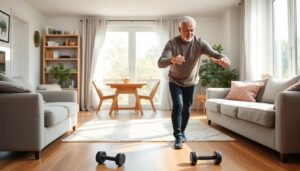
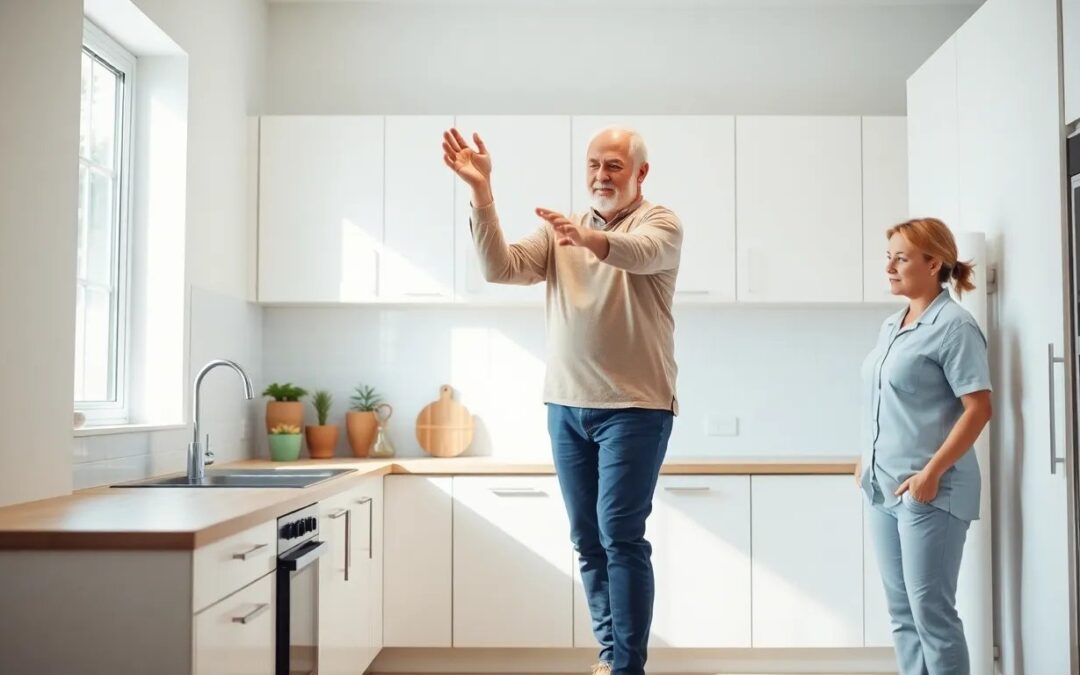
Falls Kill More Canadian Seniors Than Car Accidents. Balance Training Changes That.
Every year, more than 20,000 Canadian seniors are hospitalized from falls. That’s more than car accidents. More than any other type of injury. And for adults over 65, a single fall can mean a broken hip, a head injury, months of rehab, or a permanent move to long-term care.
Here’s what most people don’t know: falls aren’t inevitable. They’re not just “part of getting older.” The single most effective thing you can do to prevent falls is train your balance. Not with expensive equipment. Not at a gym. Right in your kitchen, holding onto the counter, 10 minutes a day.
These balance exercises for seniors are backed by physiotherapy research, organized by difficulty level, and designed so you can start today — even if you haven’t exercised in years. If you’re looking for a broader fitness routine, start with our complete guide to exercises for seniors and come back here for the balance-specific work.
Why Your Balance Gets Worse With Age
Balance isn’t one thing. It’s a system — and multiple parts of that system start declining after 50. Understanding why helps you target the right exercises.
Your Inner Ear Changes
The vestibular system in your inner ear tells your brain where your body is in space. After 55, the tiny hair cells that detect motion start dying off. By 70, most people have lost about 40% of those cells. Your brain gets slower, less accurate signals about whether you’re tilting, turning, or standing straight.
Muscle Loss Accelerates
You lose 3-5% of your muscle mass per decade after 30, and the rate speeds up after 60. The muscles that matter most for balance — your ankles, calves, and core — are often the first to weaken because we spend most of our day sitting.
Medications Cause Dizziness
Blood pressure meds, sleep aids, antidepressants, antihistamines — all common prescriptions for seniors, and all can cause dizziness or lightheadedness. If you’re on three or more medications, your fall risk goes up significantly. Talk to your pharmacist about which ones affect balance.
Vision Declines
Your eyes do more balance work than you realize. They help your brain orient your body. Cataracts, glaucoma, macular degeneration, and even dirty glasses reduce the visual input your brain needs to keep you steady.
The good news: balance is trainable at any age. Your brain can compensate for inner ear decline. Your muscles respond to exercise even in your 80s and 90s. The exercises below target exactly the systems that need strengthening.
Before You Start: Safety First
Balance exercises involve intentionally challenging your stability. That means safety isn’t optional — it’s the whole point. Follow these rules every single time.
- Always have something sturdy to hold onto. A kitchen counter, a heavy chair that won’t slide, a grab bar, or a walker. Not a lightweight stool. Not a table that might tip.
- Clear the area. Move throw rugs, electrical cords, pet toys, shoes — anything you could trip on. You need a clear 6-foot space around you.
- Wear supportive shoes. Not slippers, not socks, not bare feet. Flat, non-slip shoes with a firm sole. Running shoes or walking shoes work well.
- Tell someone you’re exercising. If you live alone, text a family member or friend before you start. If you’re a caregiver supervising these exercises, stay within arm’s reach.
- Stop if you feel dizzy or lightheaded. Sit down immediately. Dizziness during balance work is a sign you’re pushing too hard or there may be an underlying issue.
- Start with the beginner exercises. Even if you feel strong. Work at each level for at least 2 weeks before moving up.
If your parent recently had a fall or has been diagnosed with a balance disorder, talk to their doctor or physiotherapist before starting. A home care provider can also arrange for a physiotherapist to create a personalized program.
Beginner Balance Exercises
These balance exercises for elderly adults are safe for people who haven’t been active, who feel unsteady on their feet, or who are recovering from an illness or surgery. Hold onto the counter or a sturdy chair for all of these.
1. Weight Shifts (Side to Side)
Stand with your feet hip-width apart, both hands on the counter. Slowly shift your weight onto your right foot, lifting your left foot slightly off the floor. Hold for 5 seconds. Shift to the other side.
Do 10 shifts per side. Rest 30 seconds. Repeat for 2 sets.
This teaches your brain to manage weight transfer — the exact motion that fails when you stumble.
2. Heel-to-Toe Stand
Place your right foot directly in front of your left, heel touching toe, like you’re standing on a tightrope. Hold the counter with one or both hands. Hold this position for 10 seconds. Switch feet.
Do 5 holds per side. Work up to 20 seconds per hold.
3. Single Leg Stand (With Support)
Hold the counter with both hands. Lift your right foot a few inches off the floor. Stand on your left leg for 10 seconds. Switch sides.
Do 5 holds per leg. Work up to 30 seconds. As you improve, try holding with one hand, then just fingertips.
This is the gold standard fall prevention exercise. Research consistently shows that single-leg balance time is one of the best predictors of fall risk.
4. Marching in Place
Hold the counter with one hand. March in place, lifting your knees to hip height (or as high as comfortable). Go slowly — this isn’t cardio. The goal is controlled, deliberate leg lifts.
March for 30 seconds. Rest 15 seconds. Repeat for 3 sets.
5. Side Stepping
Stand facing the counter, both hands resting on it. Step sideways to the right, bringing your feet together after each step. Take 10 steps right, then 10 steps left.
Do 3 sets in each direction. Keep your steps controlled and even — no rushing.
6. Heel Raises
Hold the counter with both hands. Slowly rise up onto your toes, lifting your heels as high as you can. Hold for 3 seconds at the top. Slowly lower back down.
Do 10 raises. Rest 30 seconds. Repeat for 3 sets.
This strengthens your calves and ankles — the muscles that catch you when you start to tip forward.
Intermediate Balance Exercises
Move to these after 2 weeks of consistent beginner work, or when you can hold a single leg stand for 30 seconds with one hand on the counter. These stability exercises for seniors challenge your balance system more aggressively.
1. Tandem Walk (Heel-to-Toe Walking)
Walk in a straight line, placing one foot directly in front of the other — heel touching toe. Keep one hand near the wall for safety but try not to touch it unless you need to. Look straight ahead, not down at your feet.
Walk 15-20 steps. Turn around carefully. Walk back. Do 3 laps.
2. Backward Walking
Stand near a wall or counter. Walk backward slowly, placing each foot deliberately. Keep one hand trailing along the wall. Do not look over your shoulder — trust your feet.
Walk 10 steps backward. Rest. Repeat 3 times.
Backward walking activates different balance pathways than forward walking. It’s surprisingly difficult and surprisingly effective.
3. Sit-to-Stand Without Hands
Sit in a sturdy chair (not a sofa — too soft). Cross your arms over your chest. Stand up using only your legs. Sit back down slowly — take 3 full seconds to lower yourself.
Do 8-10 repetitions. Rest 1 minute. Do 2 sets.
If you can’t stand without using your hands, start with one hand on the chair arm and work toward no hands over several weeks. This exercise builds the leg strength that prevents falls when you get up from a chair or toilet.
4. Clock Reach
Stand on your left leg, holding the counter with your left hand. Imagine you’re standing in the centre of a clock. With your right arm, reach toward 12 o’clock (straight ahead), then 3 o’clock (to your right), then 6 o’clock (behind you). Return to centre between each reach.
Do 5 full clock sequences per leg.
This forces your balance system to adapt to shifting your centre of gravity — exactly what happens when you reach for something on a shelf or bend to pick something up.
5. Toe Walks and Heel Walks
Walk 10 steps on your toes (heels off the ground), staying near the wall for safety. Then walk 10 steps on your heels (toes off the ground).
Do 3 sets of each. Rest between sets.
Advanced Balance Exercises
These are for seniors who’ve been doing balance work consistently for 4+ weeks and can hold a single leg stand for 30 seconds with no hand support. Still exercise near a wall or counter — even advanced exercisers can have an off day.
1. Single Leg Stand With Eyes Closed
Stand near the counter but don’t hold on. Stand on one leg. Once you’re stable, close your eyes. Try to hold for 10 seconds.
Do 5 holds per leg. Work up to 30 seconds.
This is hard. Closing your eyes removes visual balance input, forcing your inner ear and muscles to do all the work. Keep the counter within grabbing distance at all times. If you feel yourself swaying, open your eyes and grab on immediately.
2. Heel-to-Toe Walk Without Support
Same as the tandem walk, but now walk the line without touching the wall. Arms can be out to the sides for balance. Look straight ahead.
Walk 20 steps. Turn. Walk back. Do 3 laps.
3. Modified Tree Pose
Stand near the counter. Place the sole of your right foot against your left ankle or calf (never against the knee). Stand tall, hands at your chest in a prayer position. Hold for 15-30 seconds. Switch sides.
Do 3 holds per side. If this feels too easy, try it with your eyes closed for the last 5 seconds of each hold.
4. Step-Ups
Find a sturdy step — the bottom stair works well. Hold the railing. Step up with your right foot, bring your left foot up to meet it, then step back down leading with your left foot.
Do 10 step-ups per leading leg. Do 2 sets.
Step-ups build the strength and coordination you need for stairs — one of the most common places seniors fall.
Your Daily 10-Minute Balance Routine
You don’t need to do every exercise listed above. Here’s a 10-15 minute daily routine you can follow at the kitchen counter every morning. Pick the version that matches your level.
Beginner Routine (10 minutes)
- Weight shifts: 10 per side (2 minutes)
- Heel raises: 10 reps x 2 sets (2 minutes)
- Single leg stand: 15 seconds per leg x 3 (2 minutes)
- Marching in place: 30 seconds x 2 sets (1.5 minutes)
- Side stepping: 10 steps each way x 2 (2.5 minutes)
Intermediate Routine (12 minutes)
- Heel raises: 10 reps x 2 sets (2 minutes)
- Single leg stand: 30 seconds per leg x 3 (3 minutes)
- Tandem walk: 3 laps (2 minutes)
- Sit-to-stand: 8 reps x 2 sets (3 minutes)
- Clock reach: 3 per leg (2 minutes)
Advanced Routine (15 minutes)
- Single leg stand, eyes closed: 15 seconds per leg x 3 (2 minutes)
- Heel-to-toe walk, no support: 3 laps (3 minutes)
- Backward walking: 10 steps x 3 (2 minutes)
- Sit-to-stand without hands: 10 reps x 2 sets (3 minutes)
- Step-ups: 10 per leg (3 minutes)
- Modified tree pose: 20 seconds per side (2 minutes)
Do your balance routine at the same time every day. Morning is best — you’re rested, your medications are at baseline, and you get it done before the day gets away from you. If you’re also doing chair exercises, do those on alternate days or after your balance work.
Balance Exercises You Can Do While Doing Other Things
The fastest way to build balance into your life is to attach it to habits you already have. No extra time required.
While Brushing Your Teeth
Stand on one leg for the first minute, switch to the other leg for the second minute. Hold the bathroom counter with your free hand. You’re already standing there — might as well train your balance.
While Waiting for the Kettle
Do heel raises while the water boils. 10 up, 10 down, rest, repeat. Or practice tandem stance — one foot in front of the other, holding the counter edge.
While Watching TV
During commercials (or every 15 minutes if you’re streaming), stand up and do a single leg stand. Alternate legs each break. You can also do side steps along the back of the couch, using it for support.
While on the Phone
Stand up and do weight shifts. Side to side, 10 each way. The phone conversation keeps your brain partially distracted, which actually makes the balance challenge harder and more effective — it mimics real life, where you’re never just standing still with nothing else to think about.
While Standing in Line
Subtly shift your weight to one foot and hold. Nobody will notice. Switch every 30 seconds. This works at the grocery store, the pharmacy, the bank — anywhere you’re stuck waiting.
When Balance Problems Need a Doctor
Balance exercises are for gradual, age-related balance decline — the normal kind that responds to training. Some balance issues are medical emergencies or need professional assessment. See a doctor if:
- Balance problems appear suddenly. If you were fine yesterday and can’t walk straight today, that could indicate a stroke, inner ear infection, or medication reaction. Call 911 if it comes with slurred speech, facial drooping, or arm weakness.
- Falls are increasing. If you’ve fallen two or more times in the past 6 months, your doctor should do a full fall risk assessment. This is covered under provincial health plans.
- You feel dizzy when you stand up. This could be orthostatic hypotension (a blood pressure drop) — often caused by medications and very treatable once identified.
- The room spins. Vertigo (a spinning sensation) is usually an inner ear issue like BPPV (benign paroxysmal positional vertigo). A physiotherapist can often fix it in one or two sessions with a specific head manoeuvre.
- You’ve stopped doing things because you’re afraid of falling. Fear of falling is itself a major risk factor for falls — it makes you move less, which makes your balance worse. A physiotherapist can help break that cycle.
In Canada, you can get a physiotherapy referral from your family doctor, or in most provinces, you can see a physiotherapist directly without a referral. Many home care providers in Toronto and Vancouver include physiotherapy in their service packages.
Frequently Asked Questions
How often should seniors do balance exercises?
Every day, ideally. Balance is a skill, and skills need daily practice. Even 10 minutes a day produces measurable improvements within 2-4 weeks. The Public Health Agency of Canada recommends balance activities at least 2 days per week as a minimum, but daily practice gets better results.
Can balance exercises reverse fall risk?
Yes. A landmark study published in the British Medical Journal found that balance and strength exercises reduce falls in older adults by 23%. For high-risk seniors, structured balance programs can reduce fall risk by up to 40%. The exercises in this guide target the exact systems — ankle strength, weight transfer, vestibular adaptation — that research identifies as most protective.
What is the best balance exercise for elderly beginners?
The single leg stand with counter support. It’s simple, safe, measurable (you can time yourself), and directly trains the balance response you need when you stumble. Start with 10-second holds and work up to 30 seconds per leg. If that’s too hard, start with weight shifts.
Are balance exercises safe for seniors with arthritis?
Yes, for most people. Balance exercises are low-impact and don’t require bending or twisting affected joints. If you have severe knee or hip arthritis, skip the sit-to-stand and step-ups until you’ve talked to a physiotherapist. The standing exercises — weight shifts, single leg stands, heel raises — are generally safe and can actually reduce joint stiffness over time.
Should I do balance exercises if I use a walker or cane?
Absolutely. Use your walker or cane as your support during balance exercises instead of the counter. Many of the beginner exercises — weight shifts, marching in place, heel raises — work perfectly with a walker. The goal isn’t to ditch the mobility aid. It’s to get stronger and more stable whether you’re using the aid or not. Ask your physiotherapist to adapt exercises for your specific device.
Start Today — Your Balance Won’t Improve By Waiting
Every week you don’t train your balance, it gets a little worse. Every week you do, it gets a little better. That’s the simplest equation in senior fitness.
You don’t need a gym membership, special equipment, or a personal trainer. You need a kitchen counter, 10 minutes, and the willingness to start. Begin with the beginner routine above. Do it tomorrow morning while the coffee brews. Do it the next day. By the end of the month, you’ll feel the difference.
If you or your parent needs help getting started safely — or if balance has declined to the point where professional support would help — AgePlaceHub connects you with home care providers across Canada who offer physiotherapy and exercise support.
Find senior care providers near you:
- Senior care in Toronto
- Senior care in Vancouver
- Senior care in Ottawa
- Senior care in Calgary
- Senior care in Winnipeg