Transport Adapté in Quebec: Who Qualifies, What It Costs, How to Apply
September 16, 2026 · 5 min read
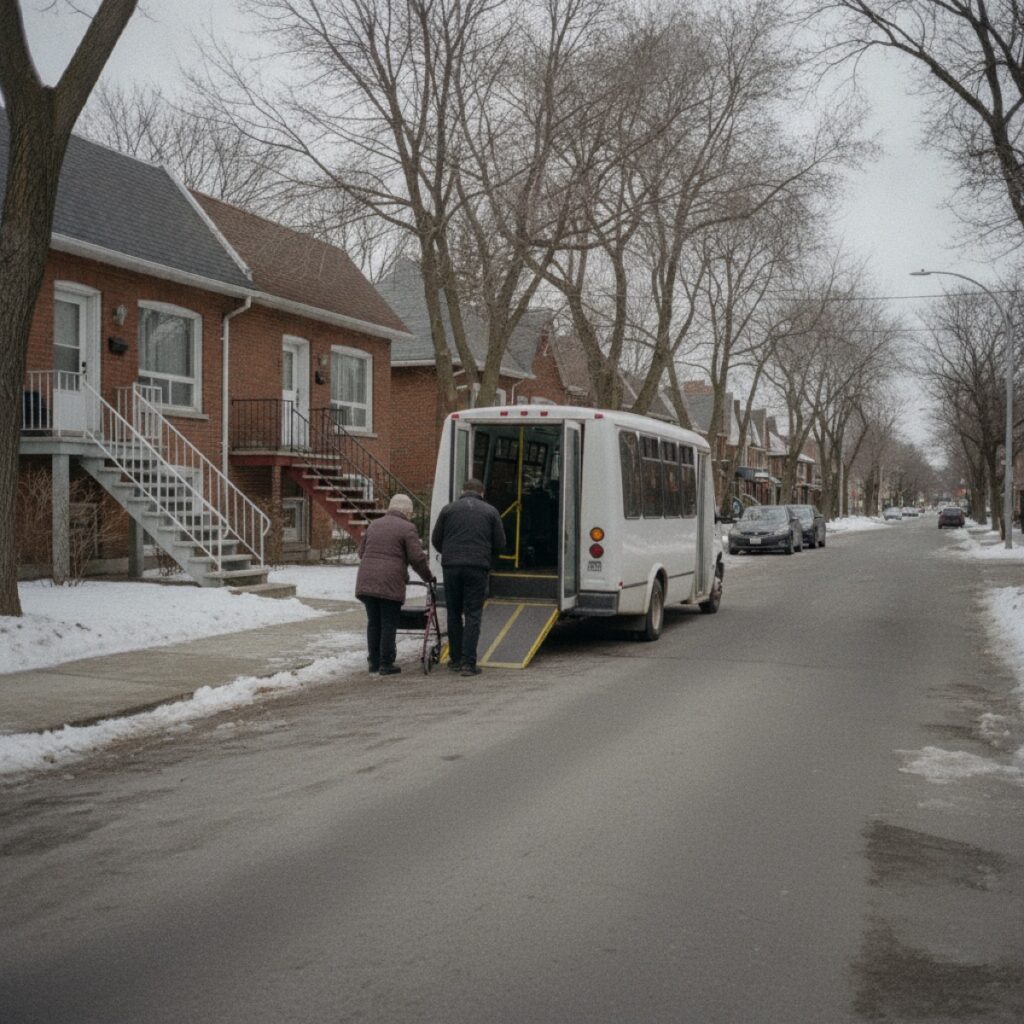
Your mother can’t take the bus any more. Walking to the stop takes too long, the step up has become a risk, and you find yourself driving across town three times a week for appointments. There is a public service built for exactly this, and most families only hear about it years too late.
The short answer: transport adapté is a public door-to-door, reservation-only service run by your municipal transit authority. You have to be found eligible by a committee first, and the answer comes within 45 days. The central test: being unable to walk 400 metres on flat ground, or unable to climb a 35 cm step. The fare is the same as regular transit, a companion travels free, and in Montreal anyone 65 or over living in the agglomeration travels free.
What it actually is
Transport adapté is not a taxi and it is not an ambulance. It is door-to-door public transit: the vehicle collects the person at home and drops them at their destination, but other passengers may be picked up along the way. You book in advance, and it runs to a schedule rather than on demand.
That distinction matters for what you expect. A trip can take longer than the same journey by car because the vehicle makes other stops. In exchange, you pay transit fare rather than taxi fare.
Who qualifies
Eligibility has nothing to do with age. It depends on mobility. The ministry sets the criteria, and you need to meet at least one of them:
- Unable to walk 400 metres on flat ground
- Unable to climb a 35 cm step with support, or descend one without support
- Unable to complete a trip on regular transit because of extreme fatigue
- Difficulty with orientation in space or time
- Difficulty managing behaviours that compromise safety
These test incapacity, not diagnosis. A fit 80-year-old does not qualify. A 62-year-old who cannot walk 400 metres does.
The fourth criterion deserves attention, because families overlook it. Difficulty with orientation in space or time covers early dementia. If your parent gets lost on a route they have taken for twenty years, that is grounds for eligibility even if they walk perfectly well.
The four types of admission
- General admission: all trips, any time.
- Partial admission: only certain trips or certain circumstances.
- Provisional admission: all trips, for a set period. Useful after surgery or during recovery.
- Seasonal admission: winter only. This is the one families miss most often, and it is exactly the profile of someone who manages fine in summer and stops going out at the first ice.
How to apply
- Contact the transport adapté service in your municipality for the form. Your local transit authority administers it, not the provincial government.
- Have the medical section completed. A health professional has to attest to the incapacity.
- Supply the requested documents, including proof of identity.
- Wait for the decision. An admission committee decides, made up of representatives from the transport body, from people with disabilities, and from the health and social services network. You receive a written answer within 45 days of a complete file being received.
That 45-day window is the reason to apply before you need it. A family starting after a hospital stay waits six weeks while somebody does the driving.
What it costs
Far less than people assume, and often nothing at all.
In Montreal, transport adapté uses the same fares and the same passes as the regular STM network. Daily, weekly, monthly and four-month passes all apply.
A companion travels free. Admission to transport adapté entitles the person accompanying you to travel at no charge during the trip. Better still, on the regular network a companion also travels free at any time on presentation of the transport adapté card.
And free travel at 65. In Montreal, people aged 65 and over who live in the agglomeration travel free in Zone A: metro, bus, exo train, REM, river shuttle, collective taxi, and transport adapté.
The detail that saves time: if your parent is a transport adapté client, is 65 or over and lives in Montreal, they need do nothing at all. Eligibility is validated automatically at the time of booking from their file. It is only to use the metro, bus, train or REM free that they need the fare loaded onto a photo OPUS card at a station or ticket office.
Booking a trip
The service runs on reservation only. In Montreal you manage trips online through Mon transport adapté, formerly SIRTA, which avoids waiting on the phone and lets you track the vehicle in real time.
Book as early as you can. A given day fills up, and a medical appointment missed because nothing was available is a common and entirely avoidable frustration.
If you are refused, or the service does not exist where you live
A refusal is not final. Incapacity changes, and you can reapply if your parent’s condition worsens. If a refusal seems wrong, ask for the reasons in writing and have the medical assessment redone by the professional who treats them.
Some territories are not served. Quebec runs a financial assistance program for transport adapté in unserved territories, so ask your municipality rather than assuming nothing exists.
There are also private adapted transport operators, which cost more but require no admission process and can usually organise something the same day. You can browse the transport services in our directory to find an option near you.
Frequently asked questions
Who qualifies for transport adapté in Quebec?
People whose incapacity seriously compromises their mobility. The main test is being unable to walk 400 metres on flat ground, or unable to climb a 35 cm step with support. Extreme fatigue, difficulty with orientation in space or time, and difficulty managing behaviours that compromise safety also qualify. Age alone does not.
How much does transport adapté cost?
The same as regular public transit. In Montreal that means ordinary STM fares, and people aged 65 and over living in the agglomeration travel free. A companion never pays, either on transport adapté or on the regular network when presenting the card.
How long does a transport adapté application take?
You receive a written answer within 45 days of a complete file being received. That is why it is better to apply before you need it rather than on the way out of hospital.
Can an older person with early dementia qualify?
Possibly yes. Difficulty with orientation in space or time is one of the eligibility criteria, independent of the ability to walk. Someone who gets lost on a route they used to know may qualify even if they are physically independent.
Does the companion have to pay?
No. Admission to transport adapté entitles a companion to travel free during the trip, and also free on the regular network at any time on presentation of the card.
What if my municipality does not offer transport adapté?
Ask them anyway. Quebec administers a financial assistance program for transport adapté in territories that are not served. Failing that, private adapted transport operators offer a service with no prior admission, at a higher fare.