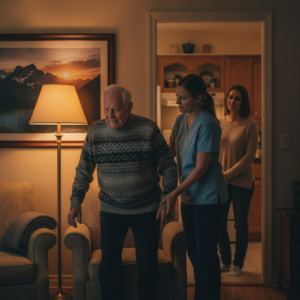

Does OHIP Cover Home Care? What Ontario Families Actually Need to Know
Your parent just came home from the hospital. The doctor said they need help at home — someone to assist with bathing, meals, maybe wound care. You assume OHIP covers it. After all, it’s healthcare, right?
The answer is: partly. And that “partly” is where most Ontario families get blindsided. OHIP does fund home care services, but what’s covered, how much you actually get, and how long you wait may not match what your family needs right now.
This guide breaks down what Ontario’s public system actually provides, where the gaps are, and what your options are for filling them — without sugarcoating it.
2026 Updates: What’s Changed for OHIP Home Care in Ontario
Ontario’s home care system has gone through significant changes over the past year. If you last looked into government-funded home care a while ago, here’s what you need to know heading into 2026.
Ontario Health atHome Is Now Fully in Place
The agency formerly known as Home and Community Care Support Services (HCCSS) — and before that, the LHINs — has completed its transition to Ontario Health atHome. The name is new, but the services and the people providing them remain the same. Ontario Health atHome is now the single point of contact for coordinating publicly funded home care across the province. You can reach them at 310-2222 (no area code needed) or through their website.
PSW Wage Increases
Ontario has made the temporary $3-per-hour PSW wage enhancement permanent, plus an additional $0.75 per hour for statutory benefits. This was a critical move to address the severe shortage of personal support workers across the province. While it hasn’t solved the staffing crisis entirely, it has helped stabilize the home care workforce and may reduce the wait times families experience when requesting PSW services through Ontario Health atHome.
Expanded Home Care Through Ontario Health Teams
An initial group of 12 Ontario Health Teams (OHTs) has been selected to accelerate integrated home care delivery in their local communities. These teams are piloting new models that aim to create seamless transitions between primary care, hospital care, and home care — particularly for people managing chronic conditions. The goal is to reduce the fragmentation that families often experience when navigating multiple care providers.
Hospital to Home Program Expansion
Ontario has expanded its Hospital to Home Program, which provides patients being discharged from hospital with expedited access to home care supports including nursing, personal support, and therapy services. If your loved one is being discharged and needs immediate home care, ask the hospital’s discharge planning team about this program — it can significantly reduce the typical wait time for services.
For a broader look at what the government offers, see our guide to government benefits for seniors in Ontario.
How Government-Funded Home Care Works in Ontario
Ontario’s publicly funded home care is managed by Ontario Health atHome (formerly the LHIN/CCAC — if you’ve heard those names, they’ve been replaced). This is the agency that coordinates home care services paid for by the province.
To access publicly funded home care, here’s the actual process:
- Step 1: Get a referral. Your family doctor, hospital discharge planner, or you can call Ontario Health atHome directly at 310-2222 (no area code needed).
- Step 2: Assessment. A care coordinator visits your parent at home to assess their needs. This can take days to weeks depending on urgency.
- Step 3: Care plan. Based on the assessment, they assign services — nursing visits, personal support workers (PSWs), physiotherapy, etc.
- Step 4: Service delivery. A contracted home care agency sends workers to your parent’s home on a schedule.
There’s no cost for publicly funded home care services in Ontario. OHIP covers it. But here’s what they don’t tell you upfront.
What OHIP Actually Covers — And What It Doesn’t
What’s Covered (Free Through Ontario Health atHome)
- Nursing care — wound care, medication management, IV therapy, injections
- Personal support workers (PSWs) — help with bathing, dressing, toileting, eating
- Physiotherapy and occupational therapy — recovery after surgery or falls
- Speech therapy — after stroke or for swallowing difficulties
- Social work — counselling, care planning, crisis support
- Dietitian services — nutrition planning for specific conditions
- Medical supplies — some wound care supplies, catheters (limited)
What’s NOT Covered
This is where families hit the wall:
- 24/7 care — The public system does not provide round-the-clock care at home. Period.
- Housekeeping and cleaning — PSWs help with personal care, not vacuuming or laundry (some light meal prep may be included).
- Companionship — If your parent is isolated and lonely, that’s not a funded service.
- Transportation — Getting to medical appointments is on you.
- Overnight care — If your parent wanders at night or needs supervision, you’ll need private help.
- Home modifications — Grab bars, ramp installations, stair lifts are not covered through home care (some separate grants exist).
The Real Problem: How Many Hours Do You Actually Get?
This is the part that shocks most families. Even though OHIP covers home care, the amount of care is often far less than what’s needed.
A typical publicly funded home care plan in Ontario provides:
- PSW visits: 2-14 hours per week (varies by assessed need)
- Nursing visits: 1-3 times per week (for specific medical tasks)
- Therapy: A few sessions, then reassessment
Let’s put that in perspective. If your parent has moderate dementia and needs help with meals, bathing, and supervision, they might need 40+ hours per week of support. The public system might provide 10-14 hours. That leaves 26+ hours per week that your family has to figure out on their own.
Options for filling the gap:
- Family caregiving — the most common solution, but leads to caregiver burnout
- Private home care agencies — you pay out of pocket, typically $25-$40/hour for PSW services
- A combination of both — public care covers some hours, private care tops it up
If you’re looking for private home care providers in your area to supplement what OHIP provides, browse home care providers across Ontario on our directory.
Wait Times: How Long Before Care Starts?
After your referral, here’s what to realistically expect:
- Hospital discharge (urgent): Care can start within 24-48 hours, but it’s often basic — a few PSW visits to get started.
- Community referral (non-urgent): The assessment alone can take 1-4 weeks. Services may start 2-6 weeks after referral.
- Waitlists for increased hours: If your parent is assessed for more hours but there aren’t enough PSWs available, they go on a waitlist. This is increasingly common due to workforce shortages.
If your family can’t wait weeks for care to start, a private home care provider can often begin within days.
Other Ontario Programs Most Families Don’t Know About
Beyond basic home care, Ontario has several programs that can help — but you usually have to ask for them. Nobody volunteers this information.
Ontario Drug Benefit (ODB)
If your parent is 65+, most prescription medications are covered with a small co-pay (about $4.11 per prescription if income is over ~$22,200 for singles). If they’re on GIS (Guaranteed Income Supplement), the co-pay drops to $2.00.
Assistive Devices Program (ADP)
Covers 75% of the cost of mobility aids like wheelchairs, walkers, hearing aids, and oxygen equipment. Your parent’s doctor or specialist needs to prescribe it.
Ontario Seniors Care at Home Tax Credit
A refundable tax credit of up to 25% of eligible medical expenses, to a maximum of $1,500. This applies to expenses like private home care, medical equipment, and attendant care. Many families miss this at tax time.
Veteran’s Independence Program (VIP)
If your parent is a veteran, Veterans Affairs Canada can fund housekeeping, groundskeeping, home care, and home modifications. This is separate from provincial programs and can be combined with OHIP-funded care.
Ontario Disability Support Program (ODSP)
For seniors under 65 with disabilities, ODSP provides income support plus extended health benefits. At 65, they transition to OAS/GIS.
Self-Directed Funding: Managing Your Own Home Care
Most families receiving OHIP-funded home care have their services arranged through Ontario Health atHome, which contracts with home care agencies to send PSWs, nurses, and therapists. But there’s another option many families don’t know about: Family-Managed Home Care, also called self-directed funding.
How Self-Directed Funding Works
Under Ontario’s Family-Managed Home Care program, instead of receiving services from an assigned agency, you receive funding directly to purchase home care services or employ your own care providers. You become the employer — choosing who provides the care, when it happens, and how the care plan is carried out.
Here’s the basic process:
- Get assessed: You must first have a care needs assessment completed by Ontario Health atHome, just like traditional home care
- Meet eligibility: You need to meet the same general eligibility requirements as traditional home care recipients
- Develop a care plan: Ontario Health atHome develops a plan of service outlining the hours and types of care you’re approved for
- Receive funding: Instead of an agency sending a worker, you receive the equivalent funding to hire your own
- Manage the care: You handle recruiting, scheduling, payroll, and all administrative tasks
Why Families Choose Self-Directed Funding
The biggest advantage is consistency. One of the most common complaints about agency-provided home care is the revolving door of different PSWs. With self-directed funding, you hire one or two PSWs who get to know your loved one, their routine, and their preferences.
Pros:
- You choose your own care provider — no more strangers showing up
- Consistent scheduling that works for your family
- Your money goes further: independent PSWs typically charge $18–$25 per hour, compared to $30–$45 per hour through agencies
- Greater flexibility in how care is delivered
- Better continuity of care, which is especially important for people with dementia
Cons:
- You take on all employer responsibilities (payroll, CPP/EI remittances, tax slips)
- You need backup plans when your PSW is sick or on vacation
- No agency oversight or supervision — quality management is on you
- Administrative workload can be stressful, especially for families already dealing with caregiver burnout
- Finding qualified PSWs independently takes time and effort
How to Apply for Family-Managed Home Care
To explore self-directed funding, contact Ontario Health atHome at 310-2222 and ask about their Family-Managed Home Care option. You’ll need to:
- Already be assessed and approved for home care services (or request an assessment)
- Demonstrate that you or a family member can manage the administrative responsibilities
- Agree to the program’s terms and reporting requirements
Not every family is a good fit for self-directed funding. If the administrative burden sounds overwhelming, traditional agency-delivered care may be the better choice. But for families frustrated by inconsistent agency care, it can be a game-changer.
What About Long-Term Care Homes?
If home care isn’t enough — whether public or private — the next step is often a long-term care home. In Ontario:
- Who pays: The government subsidizes the care portion. You pay a co-payment for accommodation, currently about $2,129-$3,042/month depending on room type (rates effective July 1, 2026).
- The waitlist: Average wait is 3-5 months for a first-choice home, but can be 1-2+ years in popular areas like Toronto and Ottawa. Learn more about the LTC waitlist.
- How to apply: Through Ontario Health atHome — same agency that coordinates home care. They do a separate assessment for LTC eligibility.
While waiting for a long-term care bed, most families use a combination of public home care + private home care + family caregiving to bridge the gap.
Retirement Homes Are Different (and Fully Private)
Retirement homes are NOT the same as long-term care. They’re private businesses — no government subsidy, no waitlist, but also no government funding. Costs range from $2,500-$7,000+/month in Ontario depending on location and level of care.
Some financial help exists:
- Subsidy programs — A few municipalities offer rent subsidies for low-income seniors in retirement homes, but availability is extremely limited.
- Tax deductions — The medical expense portion of retirement home fees may be tax-deductible if your parent requires attendant care.
Caregiver Tax Credits You Might Be Missing
If you’re paying for home care — whether privately or topping up what OHIP provides — there are several federal and provincial tax credits that can put money back in your pocket. Many families miss these because they don’t realize home care expenses qualify.
Canada Caregiver Credit (Federal)
The Canada Caregiver Credit is a non-refundable federal tax credit for individuals supporting a dependant with a physical or mental infirmity. For the 2026 tax year:
- $8,773 for an infirm spouse, common-law partner, or eligible dependant age 18 or older
- $2,740 for an infirm child under 18
- The credit is reduced when the dependant’s net income exceeds $20,601
The dependant must be your (or your spouse’s) child, grandchild, parent, grandparent, sibling, aunt, uncle, niece, or nephew — and must be a Canadian resident. You’ll need a signed statement from a medical practitioner confirming the infirmity.
Ontario Seniors Care at Home Tax Credit (Provincial)
This is a refundable provincial credit — meaning you get the money even if you owe no tax. For seniors aged 70 and older with low to moderate income:
- Covers 25% of eligible medical expenses up to $6,000
- Maximum credit: $1,500 per year
- Starts to phase out when family net income exceeds $35,000
- Fully phased out at approximately $65,000 family net income
Eligible expenses include home care services, medical equipment, and other costs that support aging at home. This credit is claimed on your Ontario tax return.
Medical Expense Tax Credit (Federal)
The Medical Expense Tax Credit (METC) allows you to claim a 15% federal non-refundable tax credit on qualifying medical costs that exceed $2,890 (or 3% of your net income, whichever is less) for any 12-month period ending in 2026. Eligible home care expenses include:
- Fees paid to a licensed nurse or practical nurse for in-home care
- Attendant care services (help with daily activities like bathing, dressing, and meal preparation)
- Salaries paid to a full-time attendant in your home
- Medical supplies and equipment prescribed by a practitioner
Important: You cannot claim the same expenses under both the Medical Expense Tax Credit and the Disability Tax Credit’s attendant care provision. Talk to your accountant about which approach saves you more.
Stacking These Credits
Here’s what many families miss: you can often claim multiple credits for different expenses. For example, you might claim the Canada Caregiver Credit for supporting your infirm parent while also claiming the Medical Expense Tax Credit for their home care costs. The key is that you cannot double-count the same expense.
For a complete breakdown of all available tax benefits, read our full guide to senior care tax credits in Canada.
So What Should Your Family Do?
Here’s a practical path forward:
- Call Ontario Health atHome (310-2222) to start the assessment process. Do this even if you’re not sure your parent qualifies — it’s free and starts the clock.
- Don’t wait for the public system to fully kick in. If your parent needs help now, find a private home care provider to bridge the gap.
- Ask about ALL programs. The care coordinator should tell you about ADP, ODB, and tax credits — but they’re overworked, so ask directly.
- Claim the tax credits. Keep receipts for every private care expense. The Ontario Seniors Care at Home Tax Credit and the federal Medical Expense Tax Credit can recover 25-40% of costs.
- Plan ahead for long-term care. If your parent’s needs are increasing, get on the LTC waitlist early while supplementing with home care.
The reality is that most Ontario families use a mix of public and private care. The public system provides a foundation — but filling the gaps is on you. Understanding what’s available and what’s not is the first step to making it work.
Frequently Asked Questions About OHIP Home Care in Ontario
Does OHIP cover home care for seniors?
Yes, OHIP covers medically necessary home care services for Ontario residents of all ages, including seniors. Services are coordinated through Ontario Health atHome and can include personal support (help with bathing, dressing, and mobility), nursing care, physiotherapy, occupational therapy, speech therapy, and social work. However, OHIP does not cover 24/7 care, housekeeping, meal preparation, or companionship services. Most seniors approved for home care receive between 2 and 14 hours per week of personal support, depending on their assessed needs. There is no direct cost to the patient for OHIP-funded home care services.
How many hours of home care does Ontario provide?
The number of hours depends entirely on your assessed care needs — there is no fixed amount that everyone receives. In practice, most seniors receive between 2 and 14 hours per week of personal support worker visits. Complex medical cases may receive more, including nursing visits. Ontario Health atHome conducts an in-home assessment using a standardized tool called the interRAI to determine your care needs and allocate hours accordingly. If your needs change over time, you can request a reassessment. Many families find that the publicly funded hours are not enough and choose to supplement with private home care services. For more on what the government provides, see our guide to government benefits for seniors in Ontario.
Can I hire my own PSW through Ontario Health atHome?
Yes, through Ontario’s Family-Managed Home Care program (also called self-directed funding). Instead of having Ontario Health atHome assign an agency to provide your care, you receive funding to hire and manage your own personal support worker directly. You’ll still need to be assessed and approved for home care services through the standard process. Once approved, you take on responsibility for recruiting, scheduling, payroll, and managing your PSW. This option gives families more control and consistency but also comes with administrative responsibilities. Contact Ontario Health atHome at 310-2222 to ask if you’re eligible for the Family-Managed Home Care program.
What is the difference between home care and long-term care in Ontario?
Home care is provided in your own home and allows you to continue living independently with support. Services are typically limited to a few hours per week and focus on specific medical and personal care needs. Long-term care (LTC) homes provide 24/7 supervised care in a residential facility for people who can no longer live safely at home. LTC homes are partially funded by the government, but residents pay a co-payment for accommodation (approximately $2,000–$2,800 per month for basic accommodation in 2026). Wait times for LTC homes can range from months to several years depending on the home and region. Home care has no accommodation cost since you stay in your own home, but the limited hours mean families often need to fill gaps with private care or family caregiving. For a deeper comparison, read our complete guide to long-term care in Canada.
How do I apply for government-funded home care in Ontario?
Applying for OHIP-funded home care is straightforward. You can self-refer — you do not need a doctor’s referral. Here’s how:
- Call Ontario Health atHome at 310-2222 (no area code needed from anywhere in Ontario)
- Request an assessment: A care coordinator will schedule an in-home visit to evaluate your needs using the interRAI assessment tool
- Receive your care plan: Based on the assessment, you’ll be assigned services and hours. This can include PSW visits, nursing, therapy, and other supports
- Services begin: A contracted home care agency will be assigned to deliver your care, or you can explore the Family-Managed Home Care option
If you’re being discharged from hospital, the hospital’s discharge planning team can also initiate a referral directly to Ontario Health atHome. Wait times for an initial assessment are typically 1–4 weeks, though urgent cases may be seen sooner. If you or a family member are experiencing caregiver burnout while waiting for services, let the care coordinator know — this can sometimes affect how quickly services are arranged.
Find Home Care Providers in Your City
Looking for private home care to supplement what OHIP provides? Browse vetted providers in your area:
- Home care providers in Toronto
- Home care providers in Ottawa
- Home care providers in Hamilton
- Home care providers in Mississauga
- Browse all Ontario providers